Almost every Shopify versus WooCommerce comparison is written for somebody opening their first store. That is a sensible audience — there are far more of them — but it means the comparisons weigh the wrong things. Ease of setup, monthly price, how many themes there are, whether you need a developer to start.
None of that decides anything at $500k. By then you have a developer or an agency, you have a design, and the monthly subscription has stopped being a rounding error in either direction. What decides it is a different, shorter list, and it is mostly about what happens over the next three years rather than the next three weeks.
We build and maintain stores on both. This is the version of the comparison we actually use with clients at that scale.
The asymmetry worth understanding first
WooCommerce runs on more stores than Shopify. Shopify carries more revenue per store, and its share among high-revenue merchants is markedly higher. Both of those things are consistently reported and both are true at once.
That asymmetry is the most useful fact in the whole comparison, and it is usually presented as a scoreboard when it is really a description of two different distributions. WooCommerce’s store count includes an enormous long tail of small, part-time and abandoned shops, because installing a free plugin costs nothing. Shopify’s population skews to businesses that decided to pay for infrastructure.
The correct reading is not “Shopify is better”. It is: as stores get larger, more of them end up on Shopify, and the reasons they do are the four below. If none of those four reasons applies to you, the asymmetry does not either.
The four things that actually decide it above $500k
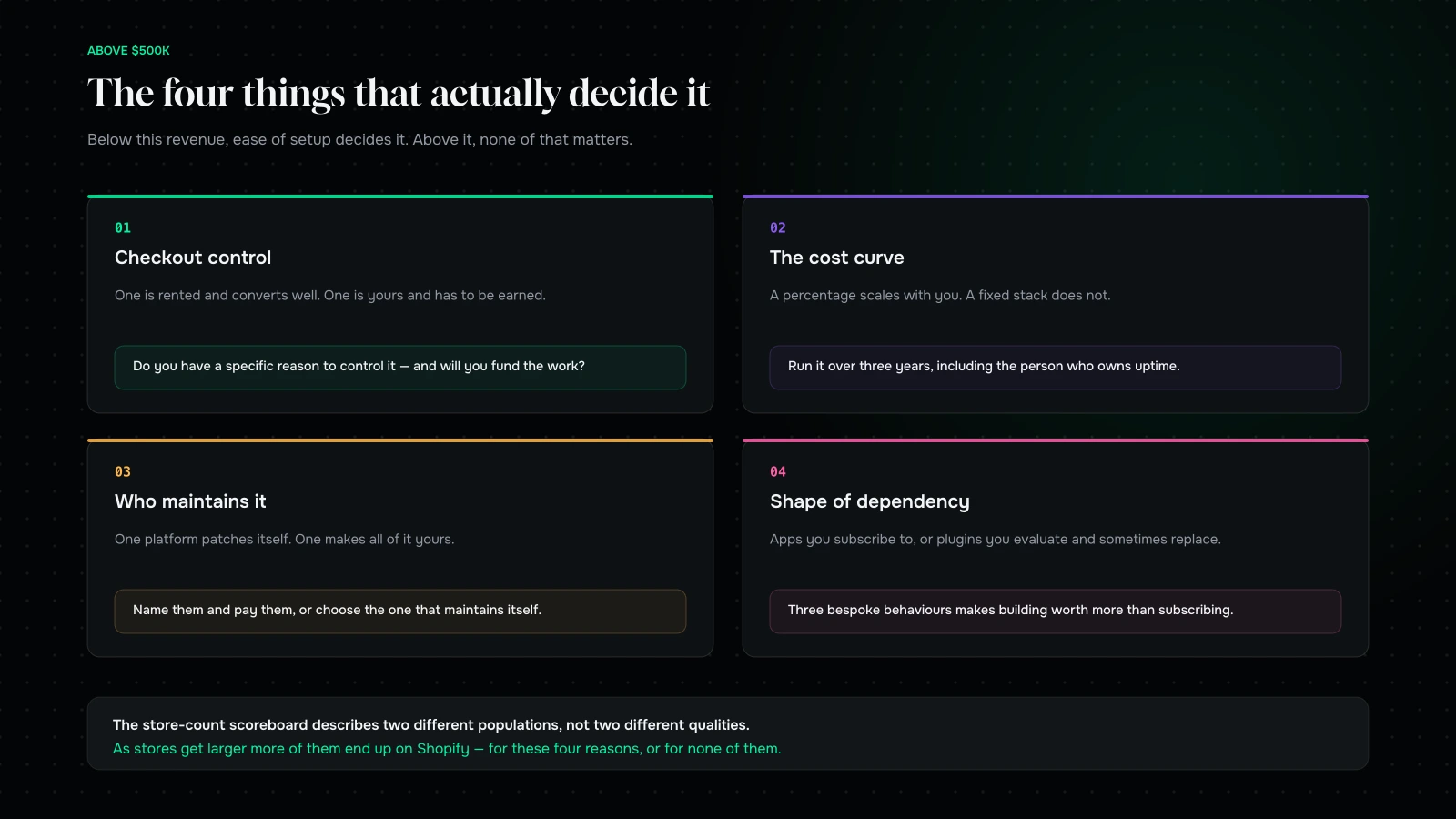
One: checkout control, and what you would do with it
Shopify’s checkout is not yours. It is very good — the product of optimisation across an enormous number of stores — and on standard plans you can adjust its appearance and very little of its behaviour. Higher tiers open more of it up, and the trend has been toward more extensibility, but the fundamental deal is unchanged: you are renting a checkout that converts well and you may not rebuild it.
WooCommerce’s checkout is entirely yours and, out of the box, converts worse. That is not a criticism of the plugin; it is a description of what a generic default looks like next to something with that much optimisation behind it.
So the question is not “which checkout is better”. It is: do you have a specific reason to control checkout, and are you willing to fund the work that makes yours as good? Regulated age checks, unusual shipping logic, B2B purchase orders, market-specific payment flows — these are real reasons. “We would like it on-brand” is not, at least not one worth the conversion risk.
Two: the cost curve, not the monthly price
Shopify’s commercial model includes a percentage on gross merchandise value when you do not use its own payments product. WooCommerce’s model is a fixed stack of hosting, maintenance and licences.
A percentage scales with you. A fixed cost does not. That single sentence is the entire cost argument, and it means the comparison flips somewhere on the revenue curve rather than being true or false in general. Below the crossover, the platform is cheaper. Above it, the fixed stack is — provided you actually pay for the fixed stack properly, which most brands underestimate.
We laid out that arithmetic in detail in when moving back off Shopify is the right call. The short version: run it over three years with projected revenue, include the person who owns uptime, and if the gap is not comfortable, the fee is not your problem.
Three: who maintains it in two years
This is the factor that decides most of the projects we see, and it is almost never in the comparison articles.
On Shopify, the platform maintains itself. Security patching, PCI scope, uptime and infrastructure are somebody else’s job, permanently. Your maintenance burden is apps, theme and integrations.
On WooCommerce, all of it is yours: WordPress core, PHP versions, the plugin ecosystem’s compatibility with itself, security, backups, and performance. That is entirely manageable — it is a large part of what we do — but it requires a named owner and a budget line. The stores that regret WooCommerce are, almost without exception, the ones where the agency left and nobody replaced them.
Ask the question directly: in two years, who applies the update that breaks something, and who is called at 2am? If you cannot name them and pay them, that answers the platform question by itself.
Four: the shape of your dependency
Both platforms make you dependent; they differ in shape.
On Shopify you depend on apps. They are well-maintained, they cost money monthly, forever, and they can change their pricing or disappear. Your functionality is a portfolio of subscriptions.
On WooCommerce you depend on plugins, which are cheaper, more numerous, of wildly varying quality, and occasionally abandoned. Your functionality is a portfolio of small bets that need periodic re-evaluation — plus the freedom to just build the thing properly when none of the bets is good enough.
Neither is better. But if your business has three or four genuinely bespoke behaviours, the ability to build rather than subscribe is worth real money. And if it has none, subscribing is cheaper than maintaining.
Where Shopify genuinely wins
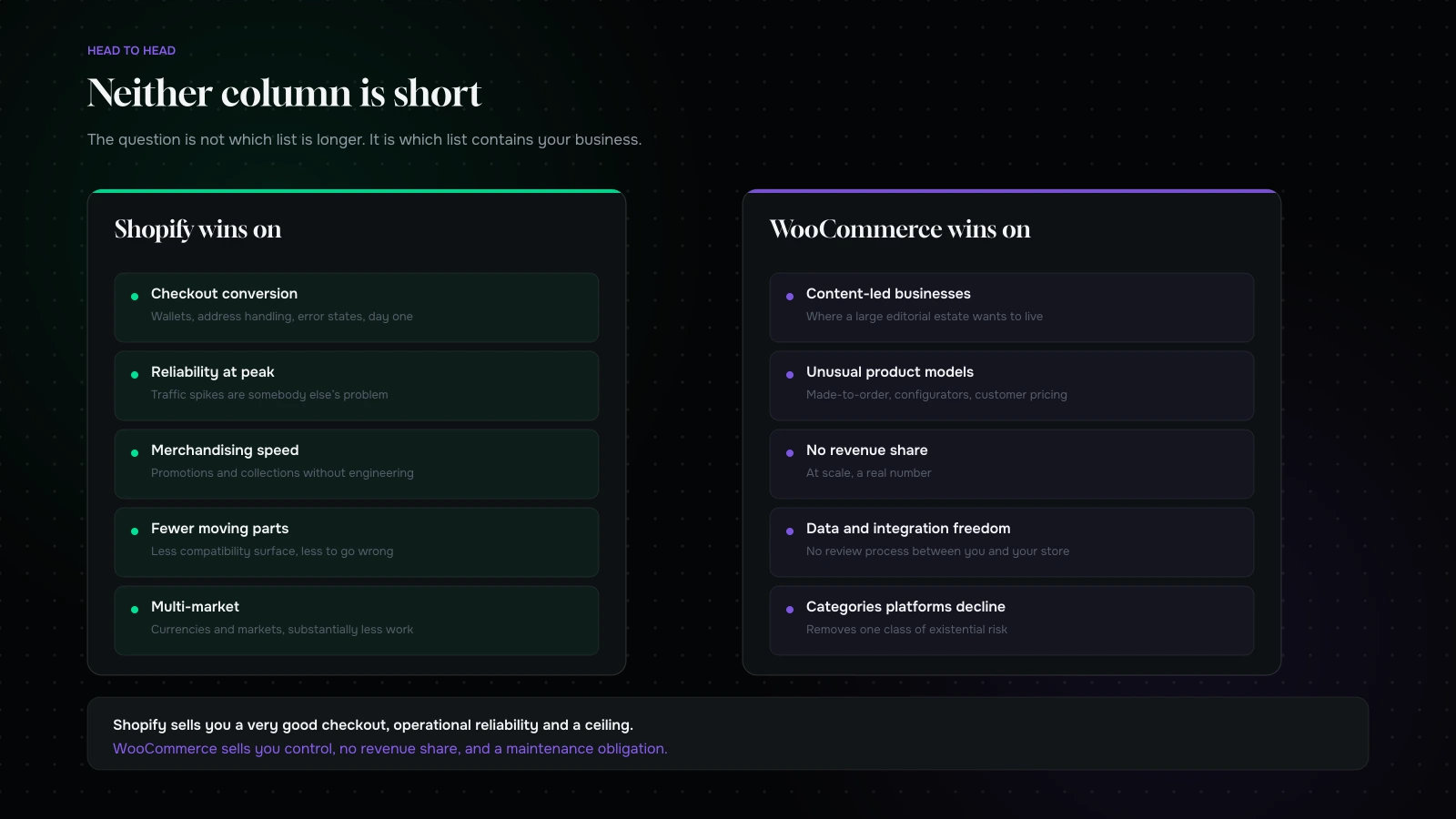
Checkout conversion, without you doing anything. Wallets, address handling, error states, mobile behaviour. All of it, working, on day one.
Operational reliability at peak. Traffic spikes are somebody else’s problem. If your revenue is concentrated into a handful of days a year, that is worth a great deal.
Speed of merchandising. For teams that need to launch promotions and collections without engineering, the admin is genuinely better.
Fewer moving parts. Fewer decisions, less compatibility surface, less to go wrong. Underrated.
Multi-market and multi-currency. Substantially less work than assembling the equivalent yourself.
Where WooCommerce genuinely wins
Anything content-led. If your organic traffic comes from a large body of editorial content, WordPress is where that content wants to live. This is the strongest single argument and the one most often dismissed as sentimentality.
Unusual product and pricing models. Made-to-order, dimension-based pricing, complex configurators, customer-specific pricing, catalogues where a product is really a specification.
No percentage on your revenue. At scale, meaningful.
Data and integration freedom. Direct database access, arbitrary API integrations, no review process between you and your own store.
Categories that platforms decline. If your products are legal but unwelcome to platform risk teams, self-hosting removes one class of existential risk. We go through this properly in selling restricted products online.
Speed: the honest answer
Neither platform is fast or slow. Implementations are.
Shopify gives you a good starting point and a ceiling you cannot easily exceed, because you do not control the infrastructure. WooCommerce gives you no starting point and no ceiling — a well-built WooCommerce store on good hosting with a proper caching and image strategy is very fast, and a typical one is not.
The practical difference is variance. Shopify stores cluster in a narrow band of performance. WooCommerce stores range from excellent to appalling, and which one you get is a function of who built it and who maintains it. If you do not intend to fund performance work, that variance is a risk you are taking on.
B2B, wholesale and mixed models
Worth a paragraph because it comes up constantly at this revenue band.
If you sell to businesses as well as consumers — different prices, purchase orders, net terms, minimum quantities, customer-specific catalogues — investigate this specifically and early, on both platforms. It is the area where general comparisons are least useful, where both platforms have moved fast, and where the answer depends heavily on how unusual your commercial terms are. Assume nothing you read more than a year ago is still accurate, including this paragraph.
The three-band summary
Not a scoreboard, a description of what usually happens.
| Revenue | What usually decides it | Where most land |
|---|---|---|
| Under $500k | Time to launch, cost, whether you have a developer | Shopify, usually correctly |
| $500k – $5M | Checkout, merchandising speed, who maintains it | Shopify, unless content or product model says otherwise |
| $5M+ | Fee arithmetic, control, B2B complexity, category risk | Genuinely split — and the audit matters |
How we would decide it
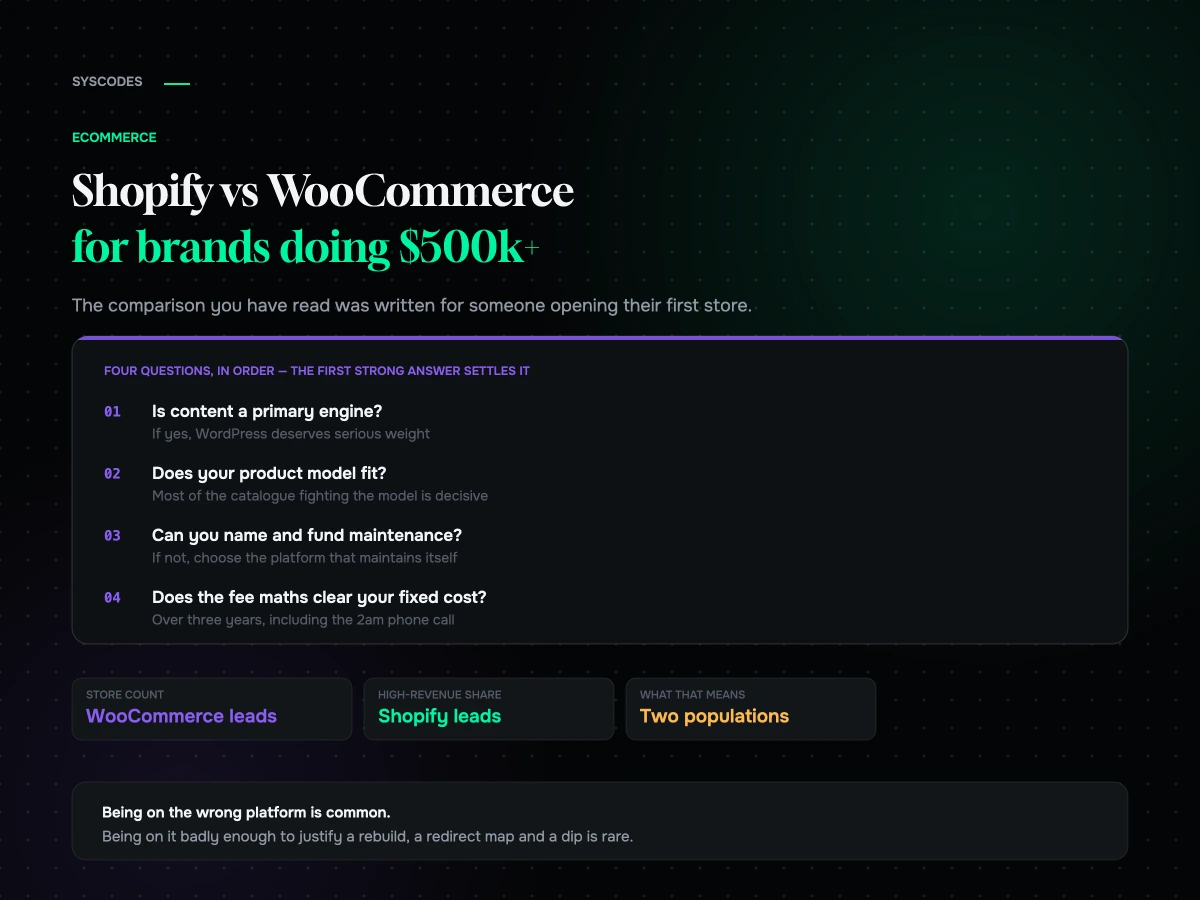
Four questions, in order. The first one that produces a strong answer usually settles it.
- Is content a primary engine of your business? If yes, WordPress deserves serious weight, either as the whole stack or as the content half of a split architecture.
- Does your product or pricing model need behaviour the platform cannot express? If yes, and it is most of the catalogue rather than a handful of products, that is decisive.
- Can you name and fund the person who owns maintenance for the next three years? If no, choose the platform that maintains itself.
- Does the fee arithmetic clear your fixed cost comfortably over three years? If no, the cost argument is not yours to make.
If you are already on one of them and asking this question, add a fifth: audit your store first, because roughly half the time the complaint that started the conversation is not about the platform at all.
Five claims the comparison articles keep making
Worth dealing with these directly, because they come up in every one of these conversations and none of them survives contact with a store doing real revenue.
“WooCommerce is better for SEO because it is WordPress.” Not in the way people mean. Both platforms can produce technically sound, fast, well-structured pages. What WordPress genuinely gives you is better content tooling — taxonomies, custom post types, editorial workflow — and if your organic traffic depends on a large body of content, that matters enormously. If your organic traffic is product and category pages, the platforms are close enough that your implementation decides it.
“Shopify locks you in.” Partly. You can export products, customers and orders. What you cannot export is the theme, the apps, or the years of configuration, and a migration off is a rebuild. But the same is true in reverse — WooCommerce does not export into Shopify either. The lock-in is in the storefront and the integrations, not in the data, and it exists in both directions.
“WooCommerce is free.” The plugin is free. Hosting, security, backups, a CDN, premium extensions and somebody’s time are not, and together they are usually larger than a Shopify subscription until you are well up the revenue curve. Free is a licensing statement, not a cost statement.
“You need a developer for WooCommerce and not for Shopify.” True at launch, much less true at $500k. By then both need somebody technical; the difference is what you need them for. On Shopify it is theme work, apps and integrations. On WooCommerce it is that plus the platform itself.
“There are more themes for X.” Above this revenue you are not buying a theme. You are building one, or heavily modifying one, and theme-count is irrelevant to both decisions.
The same brand, on both
A useful exercise: take one hypothetical brand and follow it down both paths for three years.
A supplement brand at $2M, 90 SKUs, half its traffic from a large ingredient-education blog, selling in two countries, with a wholesale side that needs different pricing.
On Shopify: the storefront ships fast and converts well. Wholesale is solved with a B2B feature or an app and needs testing but works. Multi-country is comparatively easy. The blog is the sore point — a real content operation runs into the limits of the platform’s article model within a year, and the usual answer is a second system on a subdomain, which reintroduces exactly the maintenance the platform was supposed to remove. Fees are noticeable but not decisive at $2M.
On WooCommerce: the content operation is a joy and the blog keeps compounding. Wholesale is modelled precisely, because pricing rules are code rather than configuration. The costs are performance work, an ongoing maintenance relationship, and a checkout that has to be built properly rather than inherited. Multi-country is real work.
The honest verdict for that brand is that it depends almost entirely on which of two people is more important to the business: the person running content, or the person who would otherwise own maintenance. That is usually how this decision actually resolves, and it is a staffing question dressed as a technology one.
If you are already on one of them
Most people reading this are not choosing from scratch. They are on one platform, frustrated, and using the comparison to justify a move.
Three things worth saying about that.
The comparison is not the decision. Being on the wrong platform is common; being on the wrong platform badly enough to justify a rebuild, a redirect map and a traffic dip is much rarer. The bar for moving is far higher than the bar for preferring.
Most frustration is theme debt, not platform. A store that has been extended by four developers over six years feels like a platform problem and is not one. Rebuilding the storefront on the platform you are already on gets you most of the benefit with none of the risk, and it is the verdict we give more often than any other.
And if you are moving to escape cost, do the arithmetic before the emotion. The percentage feels worse than it is at $1M and better than it is at $10M, and only one of those two is a number worth restructuring a business around.
What we would check in your first week either way
Whichever you pick, the first fortnight decides more than the platform does. Four things we would put ahead of everything else.
Instrument before you build. Analytics, server-side events, and a checkout funnel you can actually read. Teams routinely finish a build and then discover they cannot tell which step loses people. That is a two-day job at the start and a two-week retrofit later.
Set a performance budget and enforce it in review. A number for page weight and a number for third-party requests, agreed before anyone adds a chat widget. Both platforms end up slow the same way: one reasonable-sounding addition at a time.
Decide the app and plugin policy on day one. Who can install one, what has to be true for it to earn its place, and when the list gets reviewed. Every store we audit with an app problem got there without anybody deciding anything.
Write down who owns what. Theme, apps, integrations, content, infrastructure. Four names, one page. It sounds like paperwork and it is the difference between a store that is still good in three years and one that is not.
What it comes down to
At this revenue, this is not a features comparison. It is a question about which set of constraints you would rather live inside for three years.
Shopify sells you a very good checkout, operational reliability and a ceiling. WooCommerce sells you control, no revenue share and a maintenance obligation. Brands that are content-led, structurally unusual, or operating in categories platforms dislike tend to be better served by the second. Almost everybody else is better served by the first, and should stop agonising about it.
The wrong reason to choose either is a comparison table written for someone opening their first store.
Stuck between the two? Send us your revenue band, your catalogue shape and your content estate through the contact form. We will tell you which way we would go and, more usefully, which of the four questions is actually deciding it for you. We build on both, so we have no preferred answer.
You can also read what replatforming actually costs or how to audit your store first.
Tell us your revenue band, your catalogue shape and your content estate.
We will come back with which way we would go and — more usefully — which of the four questions is actually deciding it for you. Most of the time it turns out to be one of them, not all four.
If you are already on one of them and frustrated, we will tell you honestly whether the frustration is the platform or the build. It is usually the build.
More on eCommerce
Platforms, processors and the economics of selling online.

Quick commerce and ONDC: what a D2C brand should actually do
Which categories quick commerce actually works for, what listing costs, the cannibalisation test nobody runs, a realistic view of ONDC, and the channel map that holds…

COD, UPI and returns: Indian D2C economics that actually work
What a refused COD parcel really costs, the five numbers to measure, nine levers for prepaid share and RTO in the order we would pull them,…
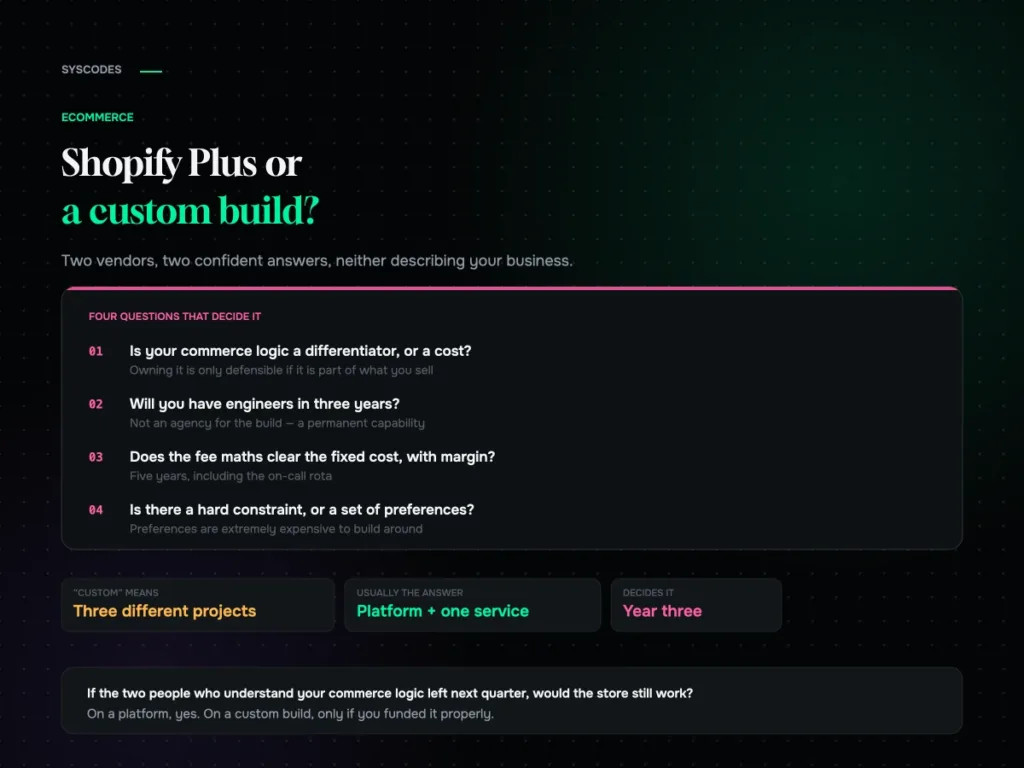
Shopify Plus vs a custom build: how to actually decide
What an enterprise commerce plan actually buys, the three boundaries where it stops, the four questions that decide a custom build, and the middle option that…
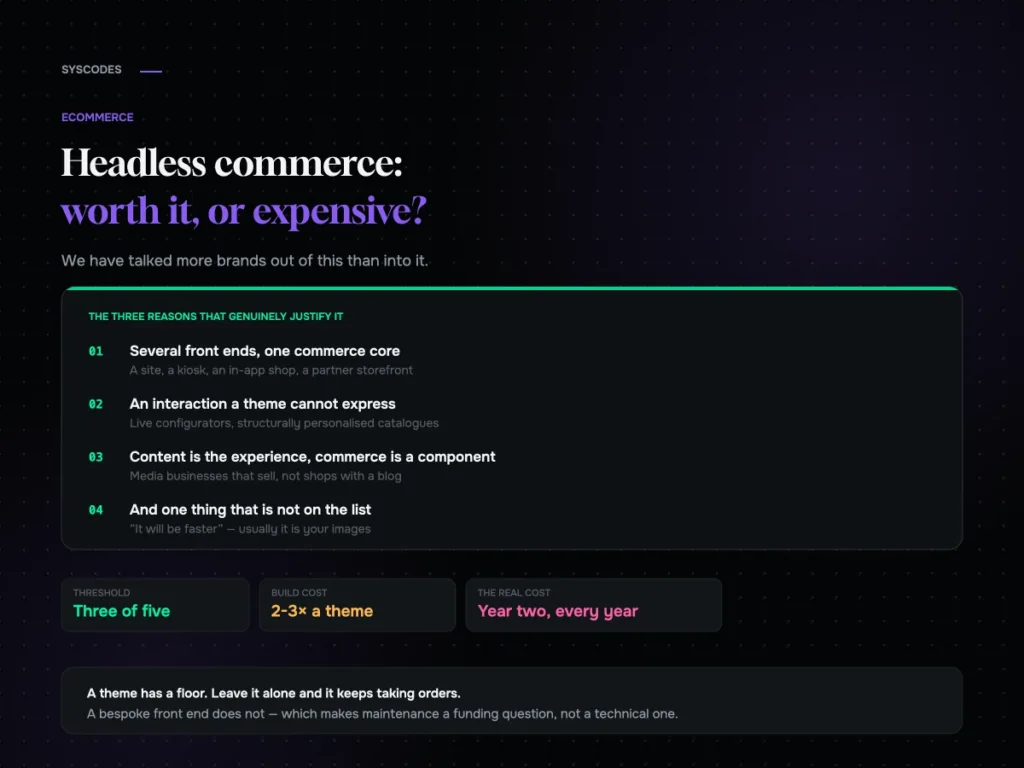
Headless commerce: when it is worth it, when it is an expensive mistake
The honest threshold for headless commerce: the three reasons that justify it, the five-question test, what you take on that used to be included, and the…
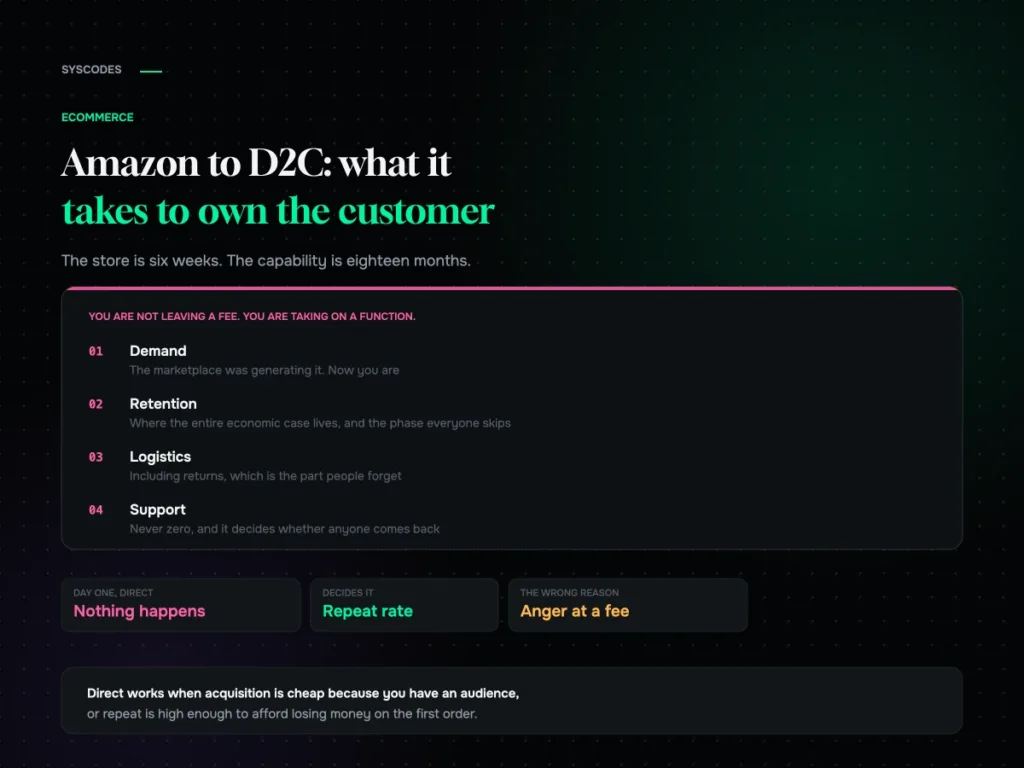
Amazon to D2C: what it takes to own the customer
The honest arithmetic of moving from Amazon to direct: what the fee was actually buying, the four capabilities you take on, why day one is silent,…

Selling a heavily regulated product online: what actually stops you
Payment processor redundancy, state-level restriction as a data model, what you cannot say in product copy, and why acquisition inverts when you cannot buy traffic.
