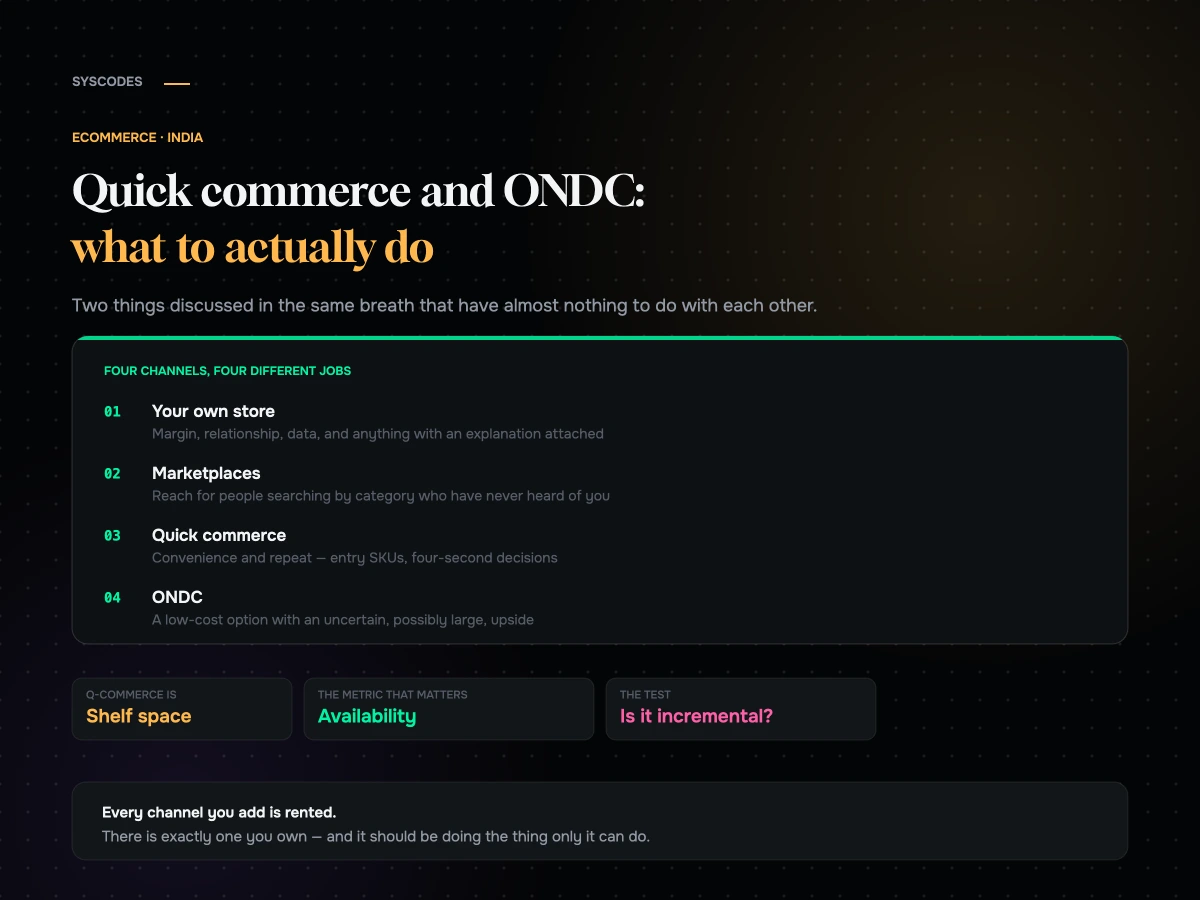
Quick commerce and ONDC get discussed in the same breath at every Indian D2C conference, and they have almost nothing to do with each other.
One is a set of very well-funded companies that have changed what “delivery” means for a specific set of categories. The other is an attempt to make commerce interoperable so that buyers and sellers are not locked into any single app. For a brand deciding where to spend the next two quarters, they demand entirely different answers, and conflating them is why so many channel strategies end up as a list of logos rather than a plan.
Here is how we would think about each, and what we would actually build.
Quick commerce, from a brand’s point of view
Strip away the delivery-time marketing and quick commerce is a distribution channel with three properties that matter to you.
It is shelf space, not a storefront. You are not building a brand experience. You are a listing in a category grid, next to competitors, being chosen in about four seconds. Everything that works there is packaging, price, ratings and whether the name is recognised.
Discovery happens inside the app. The customer opened it to buy something specific and adjacent. They did not come from your ads. This is genuinely incremental demand, which is the strongest argument for the channel.
It rewards a narrow range. These are not endless catalogues. A small number of SKUs per category get stocked, and the ones that move stay. That is a very different merchandising problem from your own store, where you can carry the long tail happily.
The consequence: quick commerce is a product decision before it is a channel decision. If your hero SKU is not obviously right for a four-second choice at a mid price point in a small pack size, the channel will not work no matter how well you negotiate.
Which categories actually work
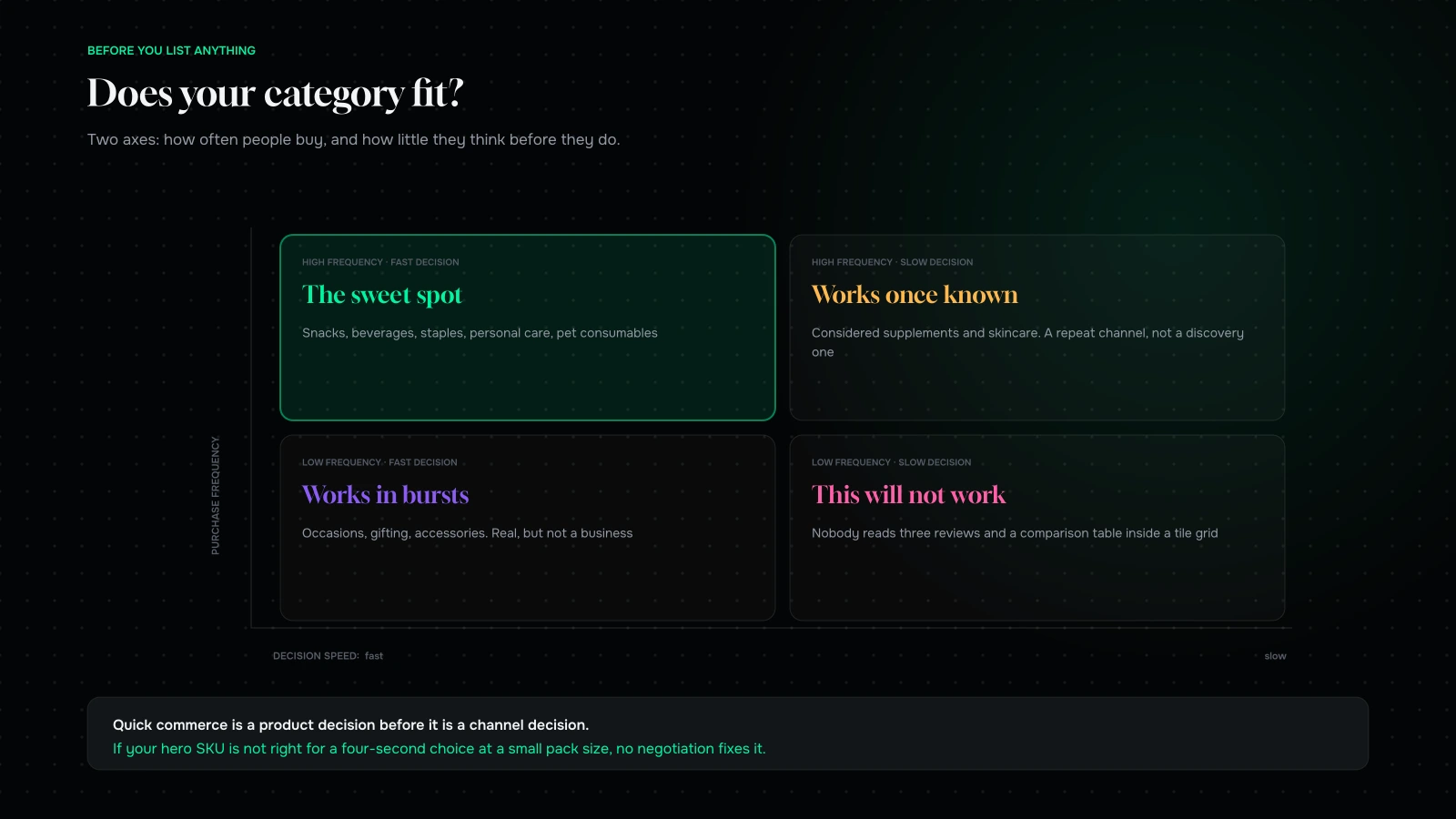
Two axes: how frequently people buy, and how quickly they decide.
High frequency, fast decision — this is the sweet spot. Snacks, beverages, staples, personal care, basic supplements, pet consumables. The customer buys often, the price point is low enough to be an impulse, and the pack size suits a rapid delivery model.
High frequency, slow decision — supplements with a considered ingredient story, skincare with a routine attached. These can work, but only once the brand is known. Quick commerce is a poor place to educate anybody, so it works as a repeat channel rather than a discovery channel.
Low frequency, fast decision — occasion-driven purchases, gifting, small electronics accessories. Works in bursts, and the burst is real, but you cannot build a business on it.
Low frequency, slow decision — considered, high-value, comparison-driven products. This does not work. If a customer wants to read three reviews and a comparison table, they are not doing it in a grid of tiles.
If you sit in the last box, quick commerce is not your channel and no amount of listing optimisation will change it. Spend the effort on your own store instead.
The economics, honestly
The margin structure is not gentle, and it is worth modelling before you commit inventory.
You will typically face a platform margin or commission, some form of listing or visibility cost if you want to be found, promotional participation that is not entirely optional, and payment and logistics costs baked into the deal. Add returns and damages, which behave differently on a rapid-delivery model than on standard shipping.
The net effect for most brands is that quick commerce sits somewhere between marketplace economics and modern trade — thinner than your own store, and with less control. What you buy with that margin is incremental volume and shelf presence you cannot otherwise get.
Two things determine whether it is worth it.
Whether the volume is genuinely incremental. If quick commerce is reaching people who would never have visited your store, the thinner margin is buying growth. If it is reaching your existing customers who now buy the same thing at lower margin, you have run a discount programme with extra steps.
Whether you can hold your price. Category grids are ruthlessly comparative, and the temptation to discount into visibility is constant. Brands that go in without a price floor spend a year training their customers to expect a lower number, which then follows them everywhere.
The cannibalisation question nobody asks
Here is the test we would run before scaling: what happens to the repeat rate on your own store in the pincodes where you are listed?
Not total revenue, which will go up and tell you nothing. The repeat rate of your direct customers, in the specific areas where a faster alternative now exists. If your existing customers migrate to a channel where you earn less and know less about them, you have converted owned revenue into rented revenue.
The mitigation is range architecture. Put the entry SKU, the single unit, the trial size on quick commerce. Keep the multipack, the subscription, the bundle, the full range and anything with a story on your own store. The two channels then serve genuinely different jobs — one buys trial, one earns margin and relationship — which is the same logic that makes a marketplace and a direct store work together rather than against each other.
Getting listed, and what happens after
Brands treat the listing as the finish line. It is closer to the start, and the six months afterwards decide whether the channel is worth anything.
Getting in is a commercial conversation, not a form. Category managers stock what sells and what supports their basket. Come with evidence: your velocity elsewhere, your ratings, your repeat rate, and a clear view of which single SKU you want stocked first. A brand asking for eight listings looks like a brand that does not know which product is its best.
Start narrow on purpose. One or two SKUs in a small number of dark stores, measured properly, beats a wide launch you cannot service. Availability is the metric these platforms actually reward, and being out of stock early is very expensive to recover from.
Availability is the whole game. A listing that is unavailable stops being shown. Then when you restock, the visibility does not simply come back — you are rebuilding from a lower base. Whatever your inventory buffer instinct is for your own store, hold more here.
Ratings compound faster than anywhere else. Small numbers of reviews, high visibility, quick decisions. A packaging fault or a batch problem shows up in the numbers within days rather than months.
Pack size is a product decision. The pack that works on your own store often does not work here — too large, too expensive, too slow to consume. Brands that do well on quick commerce usually created a format for it rather than listing what they already had.
The three questions to answer before you list anything
“Which single SKU is this channel for, and why that one?” If the answer is a list, you have not decided. Pick the one that survives a four-second choice.
“What is my price floor, and who is allowed to breach it?” Write it down before the first promotional conversation, because there will be one, and it will be urgent, and it will be framed as an opportunity.
“How will I know if this is incremental?” Decide the measurement before you launch: repeat rate on your own store in the listed pincodes, against a comparable set where you are not listed. Afterwards, everyone will argue about attribution and nobody will be able to settle it.
ONDC, without the slogans
ONDC is a set of open protocols for commerce transactions. Instead of a buyer and a seller having to be inside the same app, the network lets any compliant buyer application discover and transact with any compliant seller application.
The ambition is significant: unbundle the marketplace into discovery, transaction and fulfilment, so no single company owns the whole path between a brand and a customer. If it works fully, the economics of Indian ecommerce change in favour of sellers.
The reality for a D2C brand right now is more modest, and worth stating plainly rather than optimistically. Adoption has grown fastest in categories with strong local supply and simple fulfilment. Buyer-side traffic is distributed across a number of applications rather than concentrated in one, so volume for any individual seller varies enormously. And the seller experience depends heavily on which seller-side platform you go through, because you do not join the network directly — you join through a provider.
None of that is a reason to dismiss it. It is a reason to size the effort correctly.
What we would actually do about ONDC
Treat it as a low-cost option, not a strategy. The right amount of effort today is enough to be present and to learn, not a dedicated team. Go through a seller-side platform rather than building an integration yourself.
Get your catalogue data in order first, because that is the work that pays off regardless. Clean titles, structured attributes, consistent images, accurate stock, correct GST and HSN classification. Every channel you will ever join wants this, and most brands’ catalogue data is not ready for any of them.
Watch which buyer apps produce orders for you, and treat those as the real channels. “ONDC” is not a demand source. The applications on it are.
Do not expect it to replace anything yet. Brands that have restructured around it early have generally been disappointed. Brands that have been quietly present and kept their data clean are well positioned for whenever the volume arrives.
The honest summary: it is a genuinely important structural development and a small revenue line for most D2C brands today. Both of those are true, and the mistake is picking one.
The channel strategy that holds up
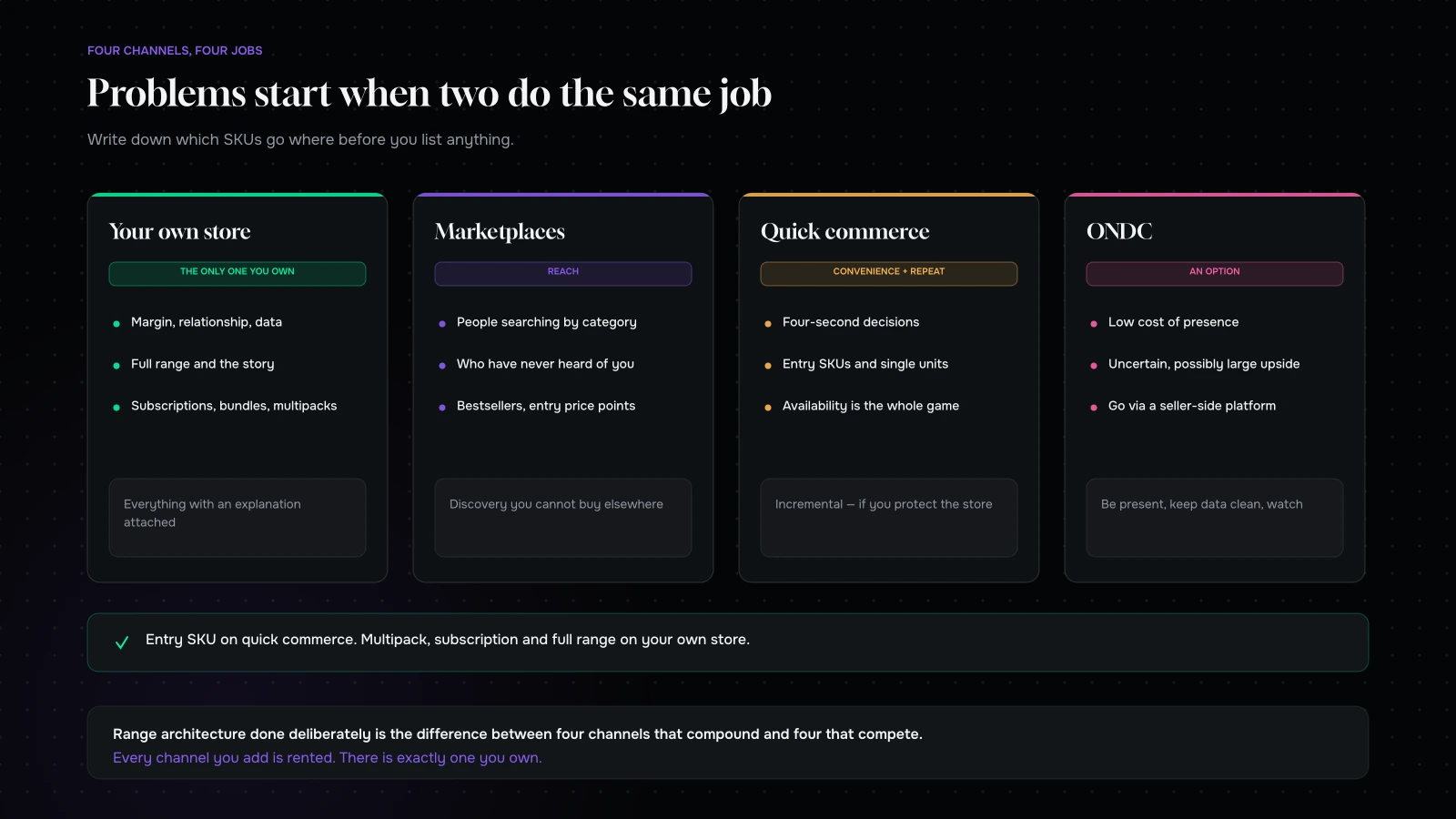
Four channels, four different jobs. Problems start when two channels are doing the same job.
- Your own store — margin, relationship, the full range, the story, the data. This is the only channel you own and it should carry anything with a subscription, a bundle or an explanation attached.
- Marketplaces — reach for people searching by category who have never heard of you. Bestsellers and entry price points.
- Quick commerce — convenience and repeat, in categories where speed genuinely matters. Entry SKUs and single units.
- ONDC — an option with a low cost of presence and an uncertain, possibly large, upside.
Write down which SKUs go where, and which do not, before you list anything. Range architecture done deliberately is the difference between four channels that compound and four channels that compete.
What your stack actually needs

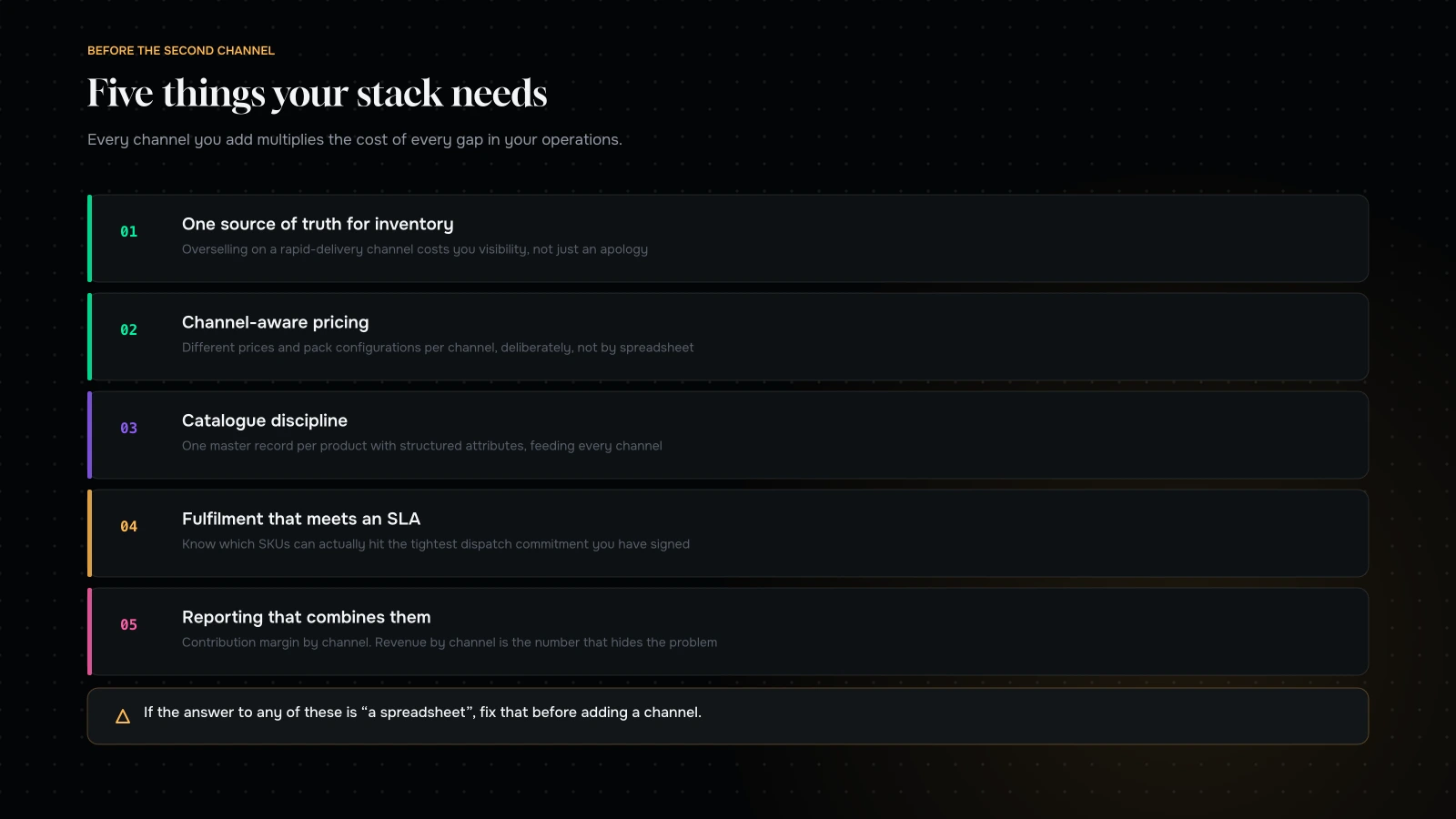
Adding channels multiplies the cost of every gap in your operations. Five things to have in place before the second channel, not after the fourth.
One source of truth for inventory. Overselling on a rapid-delivery channel is far more damaging than overselling on your own store, because the platform measures you on it and adjusts your visibility accordingly.
Channel-aware pricing. The ability to set and hold different prices and pack configurations per channel, deliberately, rather than by manual spreadsheet.
Catalogue discipline. One master record per product, with structured attributes, feeding every channel. Not a folder of spreadsheets per platform.
Fulfilment that can meet an SLA. Different channels have different dispatch commitments and penalise you for missing them. Know which of your SKUs can actually meet the tightest one.
Reporting that combines them. Contribution margin by channel, not revenue by channel. Revenue by channel is the number that hides the problem.
If your answer to any of these is “a spreadsheet”, fix that before adding a channel. It is cheaper than it sounds and it is the difference between a multi-channel brand and a brand with four unmanaged relationships.
What quick commerce does to your own store, if you let it
Two second-order effects that show up around month four and surprise people.
It resets delivery expectations. A customer who can have a competitor’s product in fifteen minutes is judging your three-day dispatch against that, whether or not the comparison is fair. You do not have to match it — most D2C brands cannot and should not try — but you do have to be explicit. A clear promised date, met consistently, is worth more than a vague fast-sounding claim, and vagueness now reads as slowness.
It changes what your product page has to do. If a share of your customers first encountered the product in a category grid, they arrive at your store already knowing what it is and wanting a reason to buy the bigger, better or subscription version. That is a different page from one written for a stranger. Brands that win on both channels usually maintain two entry paths deliberately rather than one page trying to do both jobs.
Neither of these is a reason to avoid the channel. They are reasons to expect your own store to need work once the channel is live — and to budget for it, rather than treating the listing as the end of the project.
A note on where the effort should go
If you have limited engineering and merchandising capacity — which is every brand we work with — here is the honest ranking.
First, catalogue and inventory hygiene, because it is the prerequisite for everything and it improves your existing channels immediately. Second, your own store’s checkout and repeat mechanics, because that is the only revenue you keep in full. Third, whichever single external channel best fits your hero SKU. Fourth, everything else.
The failure mode is doing all four at ten percent effort. Four half-serviced channels perform worse than one well-run one, and they cost considerably more attention.
What it comes down to
Quick commerce is a real distribution channel for a specific set of categories, with marketplace-like economics and an incremental-demand argument that is genuinely good — provided you protect your own store’s job with deliberate range architecture and a price floor.
ONDC is an important structural change that is, today, a small line for most D2C brands. Be present, keep your catalogue data clean, and watch which buyer applications actually send you orders.
And before either, make sure your own store is doing the thing only it can do. Every channel you add is rented. There is exactly one you own.
Working out where to list, and with which SKUs? Send us your range and your category through the contact form and we will come back with a channel map: what belongs where, what should stay exclusive to your store, and what your stack needs before you add the next one.
You can also read COD, UPI and returns for Indian D2C brands, or what it takes to go direct.
We will map your range across channels before you commit inventory to any of them.
Send us your range and your category. We will come back with which SKUs belong on quick commerce, what should stay exclusive to your own store, whether ONDC is worth the effort for you yet, and what your stack needs before you add the next channel.
If the honest answer is that your category does not suit quick commerce at all, we will say so — it saves a quarter of inventory and a lot of margin.
More on eCommerce
Platforms, processors and the economics of selling online.

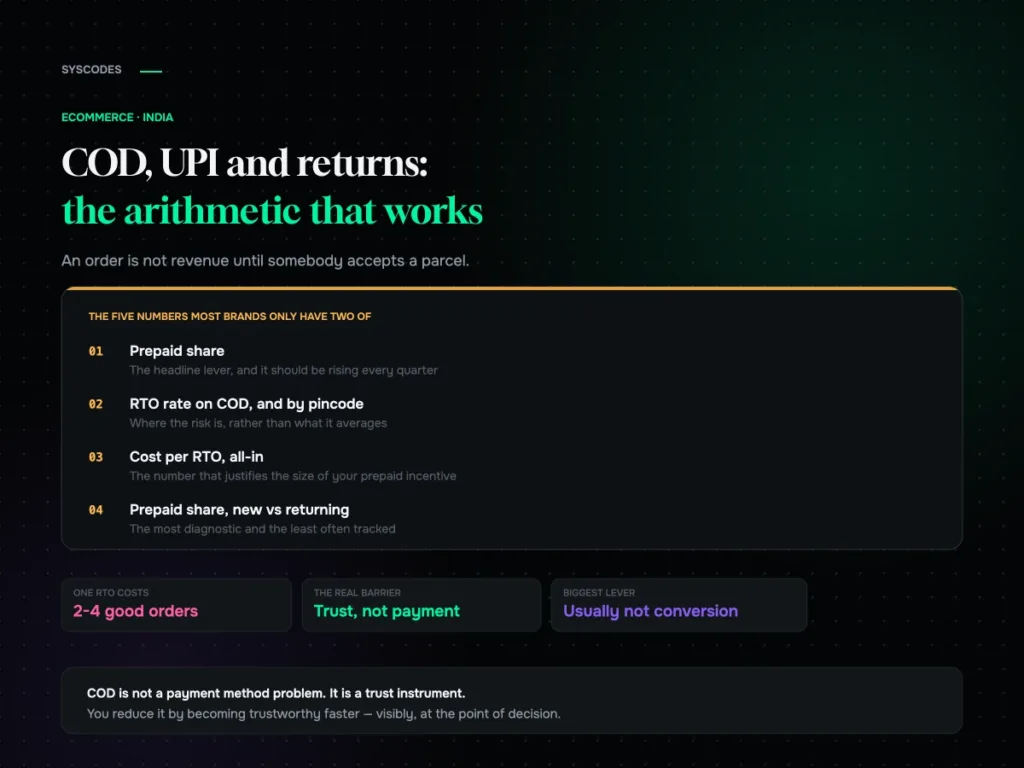
COD, UPI and returns: Indian D2C economics that actually work
What a refused COD parcel really costs, the five numbers to measure, nine levers for prepaid share and RTO in the order we would pull them,…
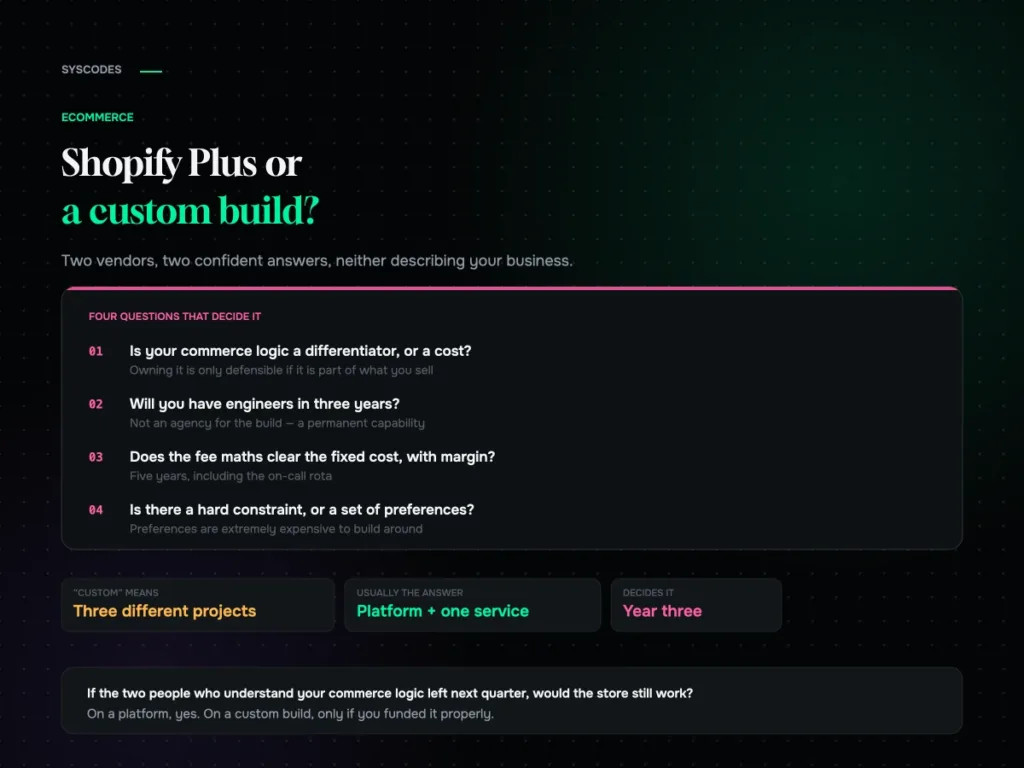
Shopify Plus vs a custom build: how to actually decide
What an enterprise commerce plan actually buys, the three boundaries where it stops, the four questions that decide a custom build, and the middle option that…
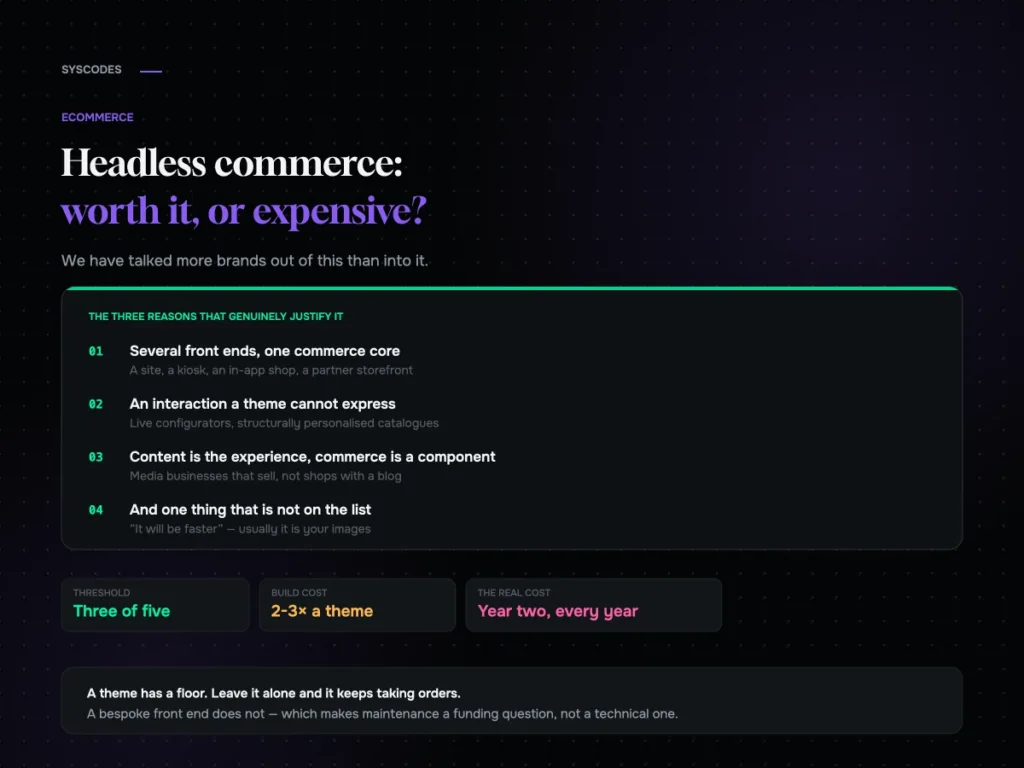
Headless commerce: when it is worth it, when it is an expensive mistake
The honest threshold for headless commerce: the three reasons that justify it, the five-question test, what you take on that used to be included, and the…
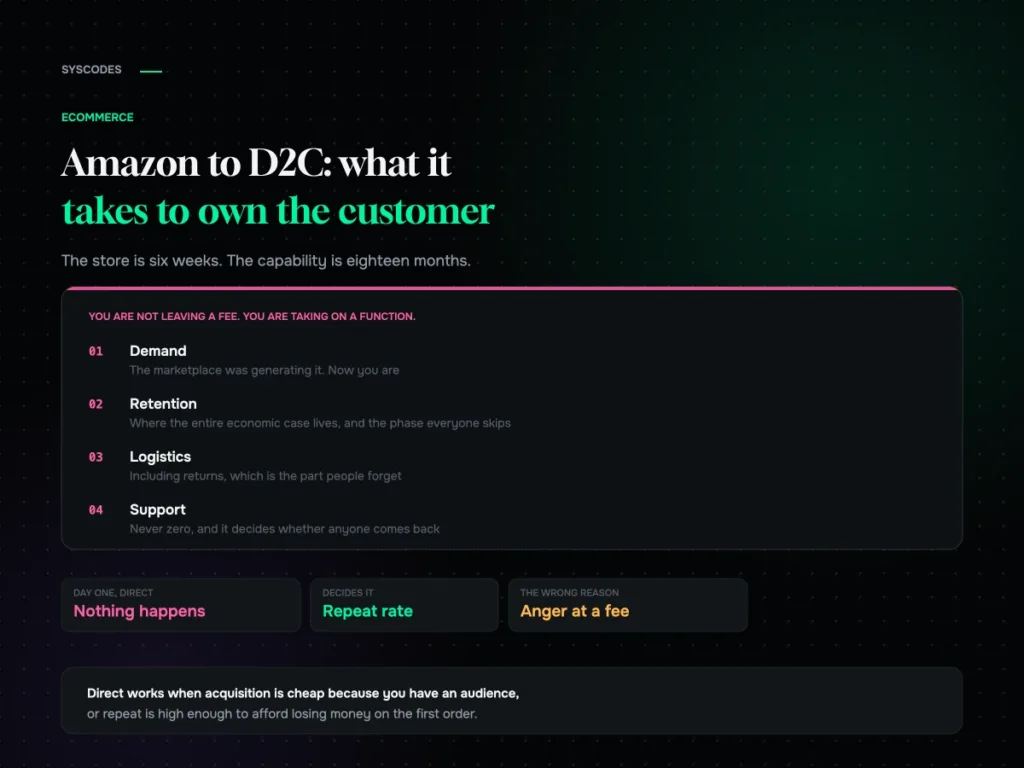
Amazon to D2C: what it takes to own the customer
The honest arithmetic of moving from Amazon to direct: what the fee was actually buying, the four capabilities you take on, why day one is silent,…
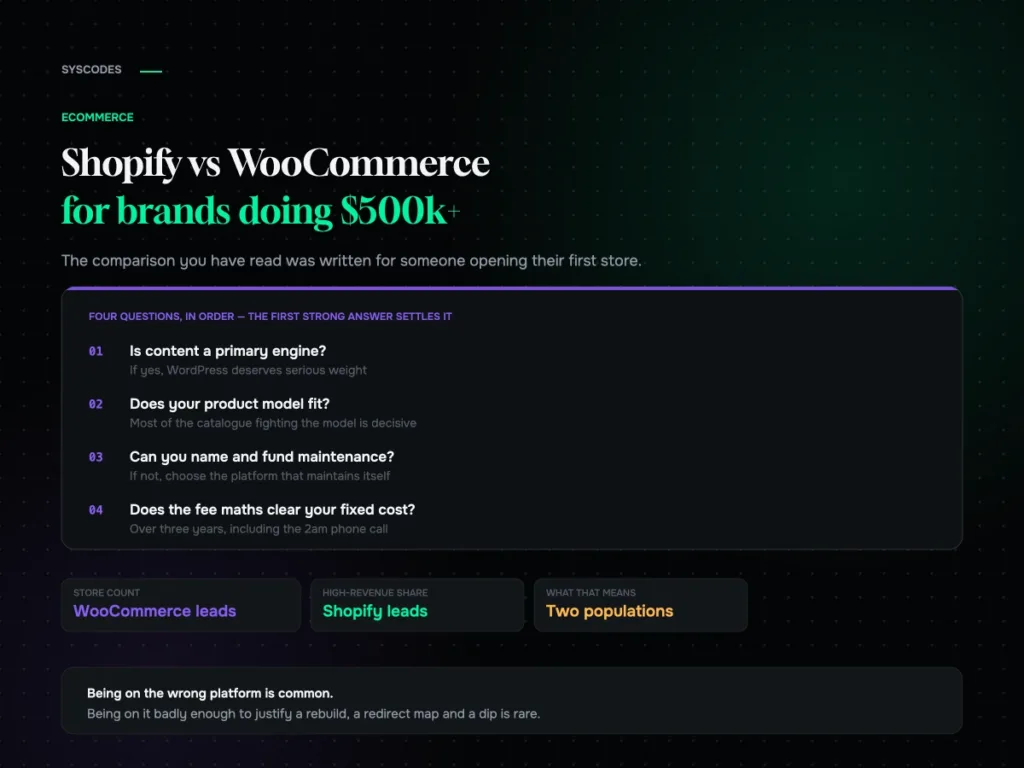
Shopify vs WooCommerce for brands doing $500k+
A Shopify vs WooCommerce comparison written for stores at scale: checkout control, the cost curve, who maintains it, dependency shape, and the five claims that do…
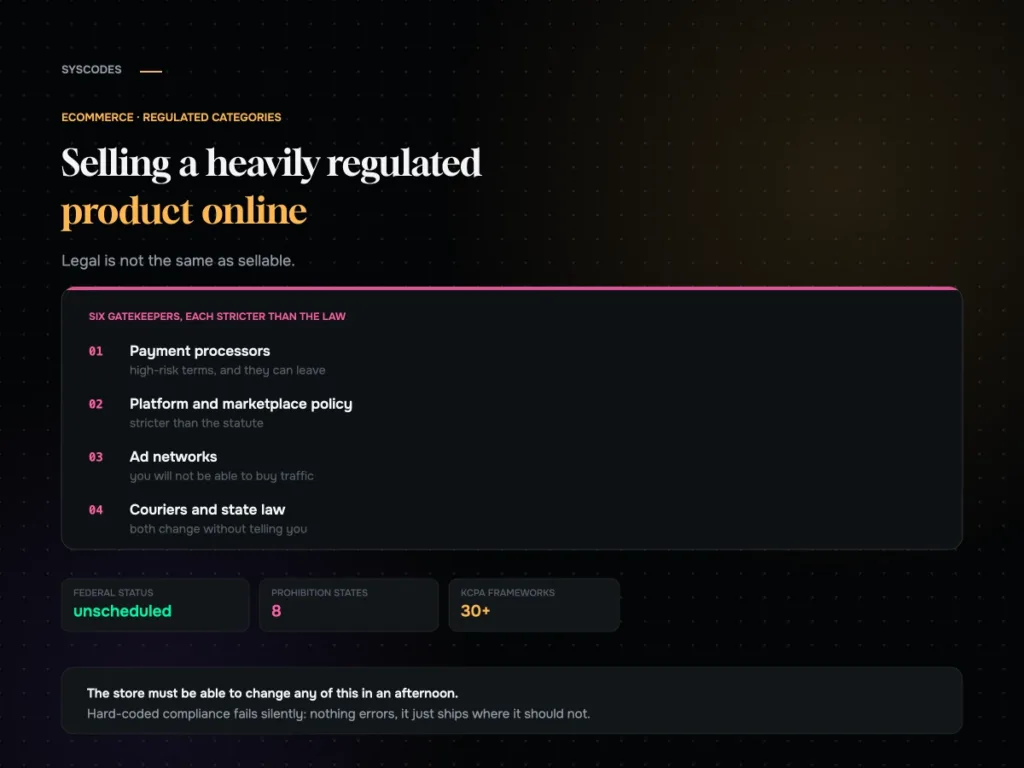
Selling a heavily regulated product online: what actually stops you
Payment processor redundancy, state-level restriction as a data model, what you cannot say in product copy, and why acquisition inverts when you cannot buy traffic.