Home/Blog/eCommerce
eCommerce · 11 min read

Amazon to D2C: what it takes to own the customer

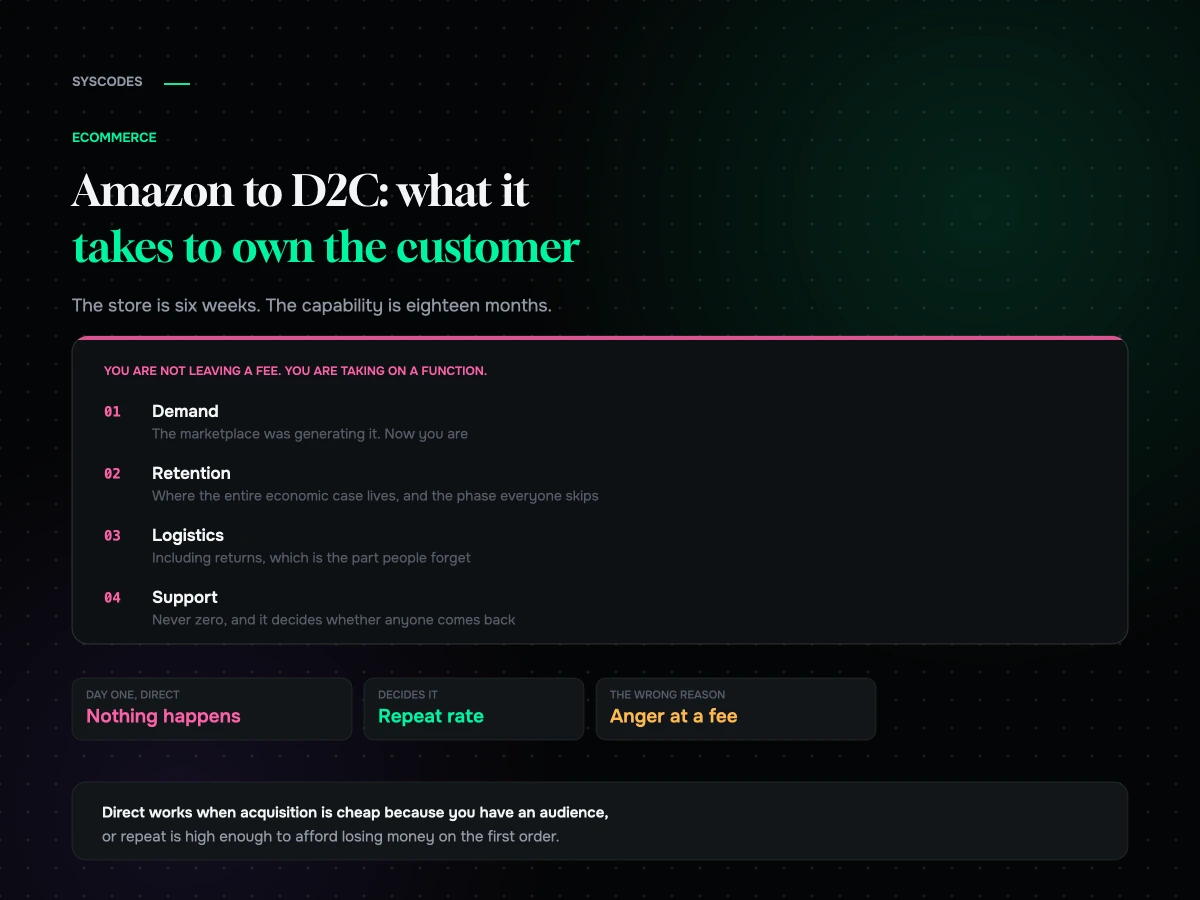
Building the store is six weeks. Building the capability is eighteen months. What you are really taking on when you leave a marketplace is the demand function — and that is the part nobody quotes for.

Amazon to D2C: what it takes to own the customer
S
Sayan SahaUpdated August 2026 · 11 min read

Every brand on a marketplace eventually has the same conversation. Margins are thin, the platform keeps changing the rules, a competitor is buying your branded search term, and somebody says the obvious thing: we should sell direct.

They are usually right, and usually about half as ready as they think.

The reason is not technical. Building the store is the easy part, and anybody quoting you for a store is quoting you for the easy part. What changes on day one of direct selling is that you have taken on a function the marketplace was doing for you, silently, in exchange for the margin you resent. That function is demand.

We took MindPanda from Amazon to direct, and the pattern has been consistent since: the store is six weeks and the capability is eighteen months.

What a marketplace is actually selling you

It is worth being precise about the trade, because the resentment usually attaches to the wrong part.

A marketplace sells you three things. Traffic, from people already in a buying frame of mind. Trust, because the returns policy and the payment guarantee belong to a brand the customer already believes. And infrastructure — fulfilment, customer service, payment, dispute handling — at a price you could not replicate at your volume.

In exchange it takes commission, fees, your customer relationship, most of your data, and control of your listing. And it competes with you, sometimes directly.

The mistake is to look at the fee line and think that is what you are paying for. You are paying for demand. When you leave, the fee stops and the demand stops with it.

The number that decides this
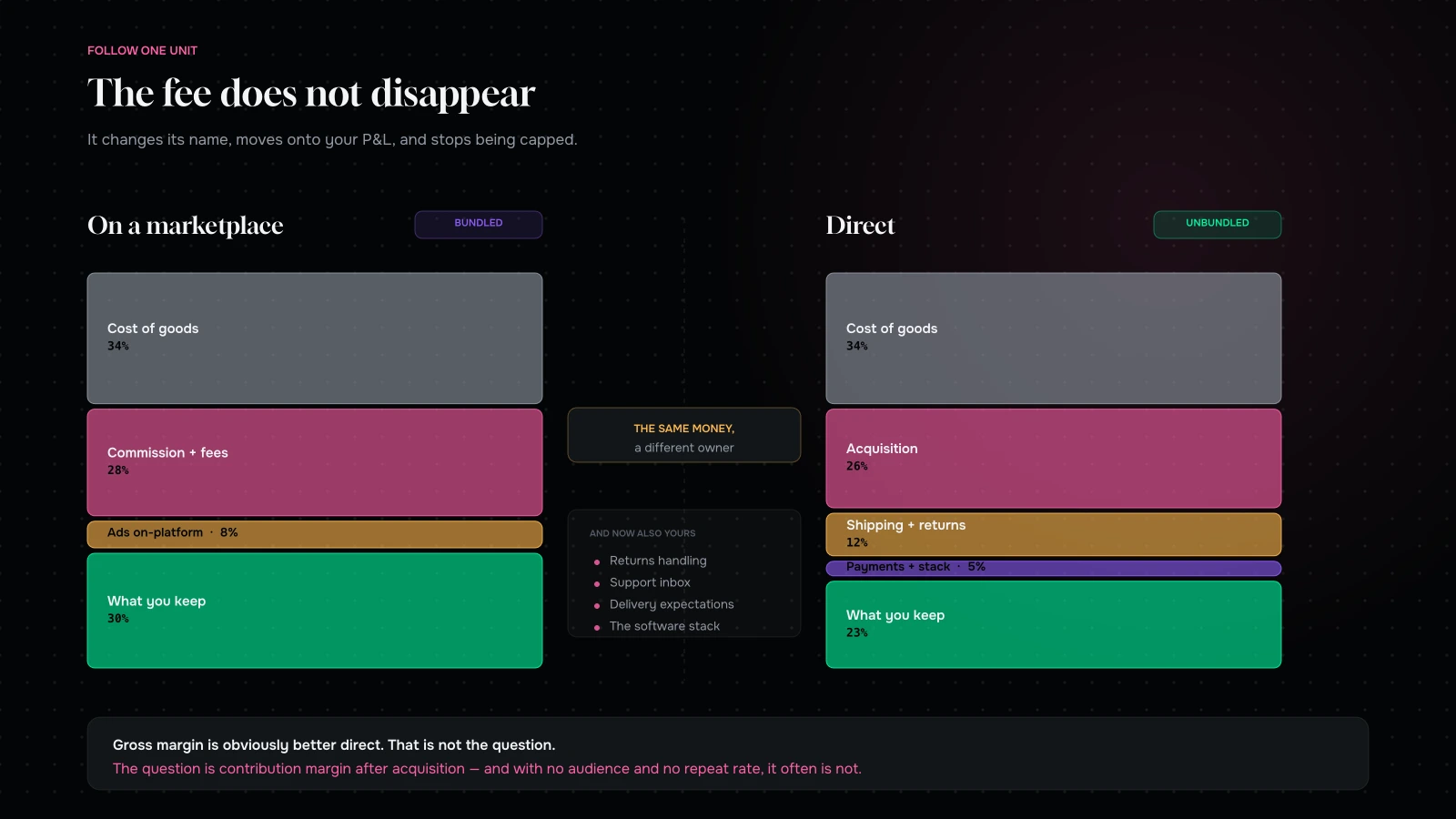
A side-by-side of marketplace and direct-to-consumer unit economics showing where the marketplace fee is replaced by customer acquisition cost
The fee does not disappear. It changes its name and becomes something you have to manage.

Take one unit and follow the money on both paths.

On the marketplace, you lose a commission and fulfilment fees, and you gain a sale you did not have to pay to generate. Your cost of demand is bundled into the fee and it is variable, predictable and capped.

Direct, you keep the commission. You now pay for the customer instead — advertising, content, affiliates, whatever it is — plus payment processing, plus shipping, plus the returns you now handle, plus the support you now answer, plus the software stack. Your cost of demand is unbundled, variable, and entirely your problem.

The honest question is not “is my margin better direct”. Gross margin is obviously better direct. The question is whether your contribution margin after acquisition cost is better direct, and for a brand with no owned audience and no repeat purchase, it often is not — at first.

Which points at the real test. Direct-to-consumer works when one of two things is true: your acquisition cost is low because you have an audience, or your repeat rate is high enough that you can afford to lose money on the first order. If neither is true yet, going direct converts a thin, safe margin into a thin, risky one.

The four capabilities you are taking on
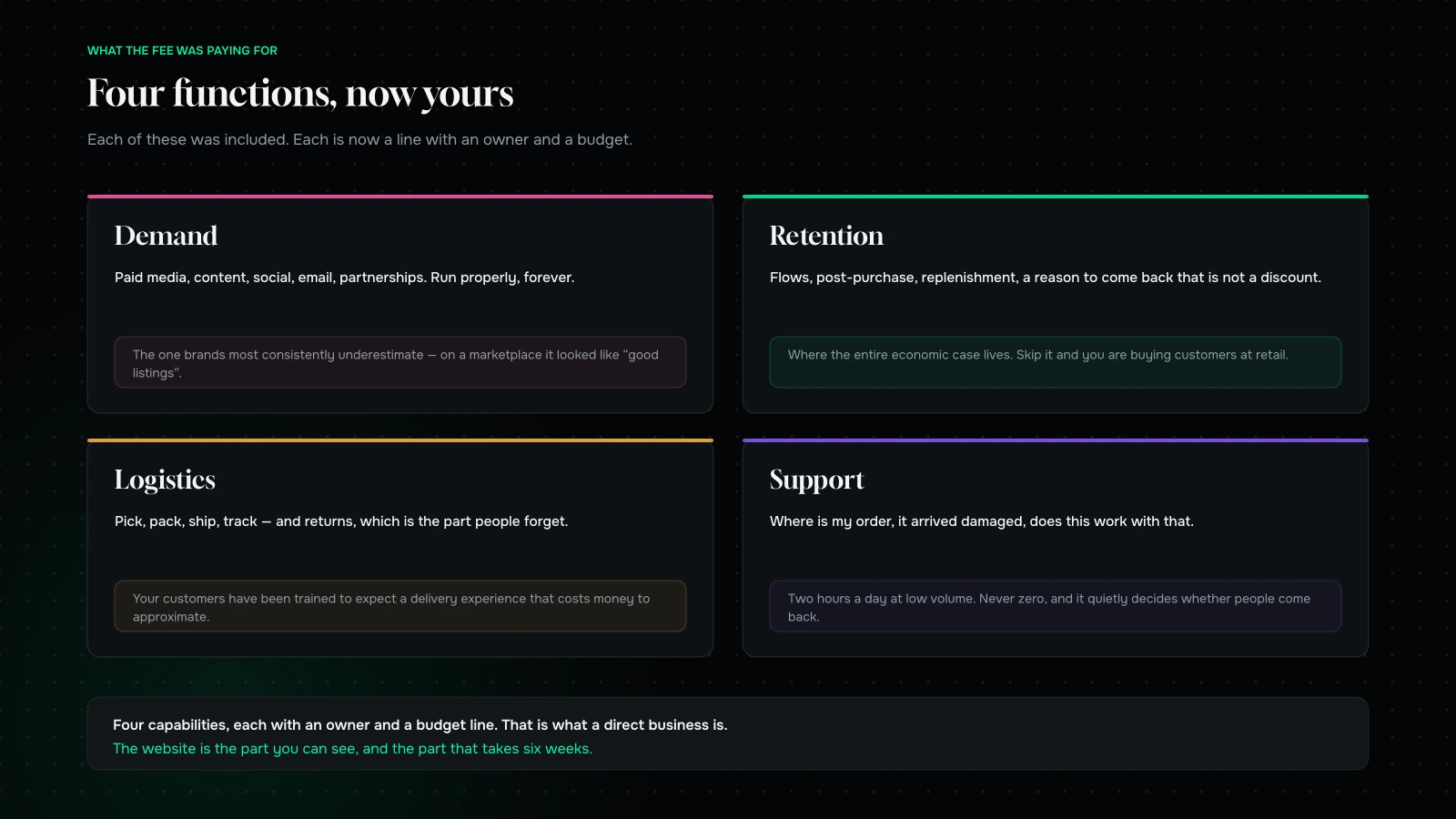
The four capabilities a brand takes on when it moves from marketplace selling to direct: demand, retention, logistics and support
Each of these was included in the fee. Each is now a function with an owner and a budget.

Demand. Somebody has to make people want the thing and know where to buy it. That is paid media, organic content, social, email, partnerships, PR — one or more of them, run properly, forever. This is the capability brands most consistently underestimate, because on a marketplace it looked like “good listings”.

Retention. On a marketplace you cannot really do this; the customer belongs to the platform. Direct, retention is where the entire economic case lives. Email and SMS flows, post-purchase sequences, subscription or replenishment where the product suits it, and a reason to come back that is not a discount. A brand that does not build this is just buying customers at retail prices.

Logistics. Pick, pack, ship, track, and — the part people forget — returns. A marketplace’s fulfilment arm has trained your customers to expect a delivery experience that costs a great deal of money to approximate. Decide early whether you are doing this in-house or with a 3PL, and get real quotes before you model anything.

Support. Every question the marketplace used to absorb now arrives in your inbox. Where is my order, it arrived damaged, I want to return it, does this work with that. At low volume this is a person for two hours a day. It is never zero.

Four capabilities, each with an owner and a budget line. That is what a direct business is. The website is the part you can see.

What day one actually looks like

Nothing happens.

This is the single most useful thing anyone can tell a brand about to go direct. You launch, and the traffic that used to arrive because you existed on a marketplace does not exist here. You get your team, your friends, and whatever you have paid for.

Brands are unprepared for this because their marketplace experience taught them that visibility is a function of listing quality and price. Direct, visibility is a function of budget and time.

Plan for it. Do not launch a direct store into silence and hope; launch it with a reason for the first thousand people to arrive — an audience you already have, a campaign you have funded, an offer that is not available on the marketplace, or a partnership. And do not measure the first month against your marketplace revenue, because that comparison will make you close it.

Why most brands should keep both, at least for a while

The framing of “leaving Amazon” is usually wrong. Most successful direct brands we work with did not leave; they added.

The marketplace does something direct cannot: it reaches people who are shopping but have never heard of you. Direct does something the marketplace cannot: it owns the relationship with people who already have. Those are different jobs, and running both deliberately is a strategy rather than a compromise.

What that looks like in practice:

  • The marketplace carries your discovery range — bestsellers, entry price points, the products people search for by category.
  • Direct carries everything else — bundles, subscriptions, limited editions, larger sizes, anything with better economics or a story to tell.
  • Every marketplace order carries a path back to you: packaging, inserts, registration for a warranty or a guide, a reason to visit that is genuinely useful rather than a naked “buy direct next time”.
  • Pricing is coordinated so you are not undercutting yourself, and value is differentiated by bundle and service rather than by headline price.

The brands that get burned are the ones who go all-in on either side. All marketplace means you never own anything. All direct, too early, means you have swapped a working channel for an ambition.

Sequencing: how we would run it

A phased sequence for moving from marketplace to direct: build the audience, launch a lean store, prove repeat, then rebalance
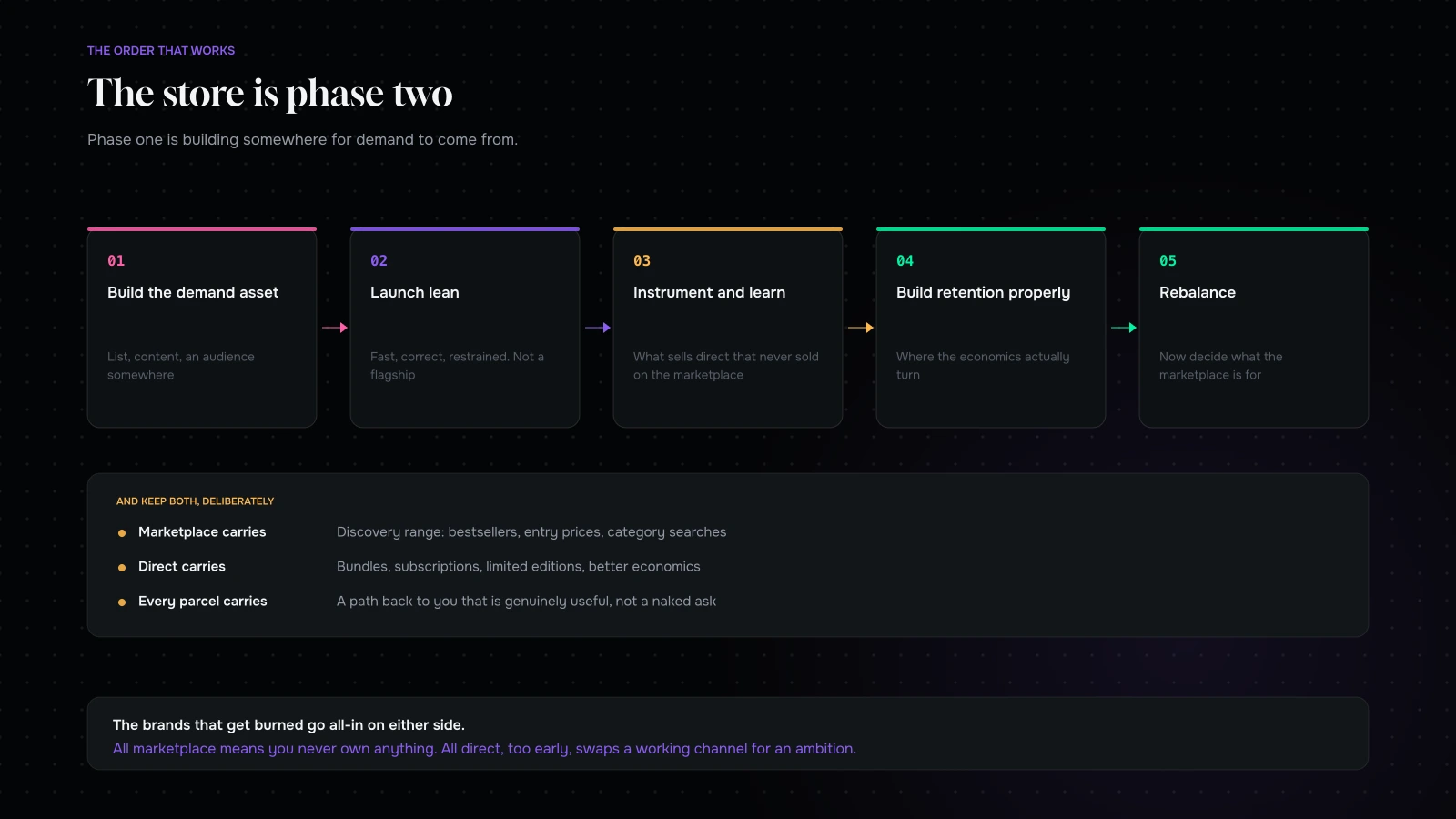
The store is phase two. Building somewhere for demand to come from is phase one.

Phase one: build the demand asset before the store. Email list, content that ranks, an audience somewhere. This is uncomfortable advice because it delays the visible bit, and it is the difference between a store that opens into an audience and one that opens into silence.

Phase two: launch lean. A fast, correct, restrained store with a good checkout and proper analytics. Not a flagship. You do not yet know what your direct customers do differently from your marketplace customers, and building for assumptions is how you end up rebuilding in a year.

Phase three: instrument and learn. Which products sell direct that never sold on the marketplace. What the repeat curve looks like. What acquisition actually costs by channel. Three months of this is worth more than any amount of pre-launch strategy.

Phase four: build retention properly. Flows, subscription if it suits, a real reason to reorder. This is where the economics turn, and it is the phase most brands skip because it is invisible.

Phase five: rebalance. Now — and only now — decide what the marketplace is for. Some brands scale back to bestsellers. Some keep it as a discovery channel indefinitely. Some genuinely leave. All three are fine, and you can only choose sensibly with your own data.
Are you ready? Six signals

You are probably ready if: you have an audience you can reach without paying for it; your repeat purchase rate is meaningful; your product has a story that a listing page cannot tell; your margins can absorb three to six months of acquisition experiments; you have somebody who will own demand as a job; and you know your marketplace numbers well enough to have a real baseline.

You are probably not ready if: your product competes mainly on price; nobody searches for your brand name; you have no email list; the plan is “launch the store and see”; the budget covers the build but not the first six months of marketing; or the reason for going direct is anger at a fee rather than a view about the business.

That last one is worth sitting with. Fee resentment is a legitimate feeling and a poor strategy.

For Indian brands, the shape is different

If you sell on Indian marketplaces, three things change the calculus.

Discovery is more concentrated. A larger share of category demand sits inside a small number of platforms, which makes the demand-building phase harder and longer, not easier.

COD changes the economics of a first order. A direct COD order carries return-to-origin risk that a marketplace absorbs for you. Model it explicitly — we go into the arithmetic in COD, UPI and returns — and consider prepaid incentives from day one rather than as a later optimisation.

Quick commerce is a third channel, not a subset of either. It behaves differently from both marketplace and direct, and for some categories it is now where the discovery happens.

The rest of the logic holds. The capability is still demand, and it still takes longer than the store.

The numbers to have in front of you before you decide

Six figures, all of which you already have or can get in an afternoon. Brands routinely make this decision without four of them.

NumberWhere it comes fromWhy it decides things
All-in marketplace take rateCommission + fulfilment + storage + ads, as a % of revenueYour real baseline, not the headline commission
Repeat purchase rateOrders per customer over 12 monthsWhether you can afford to lose money on order one
Branded search volumeSearch data for your brand nameWhether anybody is looking for you specifically
Email list size and engagementYour ESPYour only genuinely free demand
Contribution margin per unitAfter COGS, shipping, payment, returnsWhat you have to pay for a customer out of
Return rate, by channelMarketplace reports, your own dataDirect returns cost more and land on you

If your all-in take rate is above thirty percent, direct starts looking attractive fast. If your repeat rate is close to one, it stops looking attractive almost regardless of the take rate, because every sale has to be bought at full price.

What the store actually needs to do

Because the store is not the hard part, it is easy to over-build it. Three things it must do well, and a long list it does not need at launch.

Convert the traffic you have paid for. A fast product page, an honest offer, a checkout that does not lose people. That is the whole brief. We audit checkouts for a living and the failures are always the same handful of things — here is the audit.

Capture people who do not buy. Most first-time visitors will not convert, and if you have paid for them, letting them leave anonymously is the most expensive thing your store can do. Email capture that is worth someone’s address, and a reason to open the next message.

Tell you what happened. Proper analytics, channel attribution you trust to within reason, and a repeat-purchase view. You are running experiments now; experiments you cannot read are just spending.

What it does not need at launch: a loyalty programme, a quiz, a configurator, a mobile app, twelve landing pages, or a rebrand. All of those are answers to questions you have not asked yet, and every one of them slows you down.

The mistakes we see most

Launching the store before the audience. Covered above, and worth repeating because it is the most common and the most expensive.

Pricing direct below the marketplace to “encourage” the switch. It trains customers to wait for the cheaper channel and it damages your marketplace position. Differentiate on bundles, sizes, service and access instead.

Treating the first three months as a verdict. Acquisition takes time to tune. Judging the channel on month one is how brands abandon a working strategy in week nine.

Hiring an agency for the build and nobody for the demand. A common and entirely avoidable failure. The build is finite; the demand function is permanent. If the budget only stretches to one of them, buy a simpler build.

Underestimating support. It is never zero, and it is unglamorous, and it is the thing that quietly decides whether people come back.

What owning the customer is actually worth

Worth stating plainly, because the case for direct is usually made in terms of margin and margin is the least interesting part of it.

You find out why people buy. On a marketplace you see units. Direct you see the path — what they read first, what they compared, what made them hesitate, what they bought second. That information changes your product roadmap, not just your ads.

You can sell the thing that does not fit a listing. Bundles, subscriptions, personalisation, made-to-order, a size range that would confuse a marketplace grid. Some of the best margin in a brand is in products a listing page cannot express.

You can raise prices. Not immediately, and not by much, but a brand with a relationship has room a commodity listing does not.

You have somewhere to go when the rules change. Marketplaces change fee structures, algorithms and category policies without asking. Every brand that has been suspended without warning has the same regret, and it is not about margin.

And you get to build something that has a value on its own. A list, an audience and a repeat customer base are assets. Rank on somebody else’s platform is not.

None of that shows up in month one, which is precisely why the decision has to be made on a three-year view or not at all.

What it comes down to

Going direct is not a website project. It is the decision to take on the demand function yourself, permanently, in exchange for owning the customer.

That is a good trade for brands with something to say, a product people come back to, and the patience to build an audience before they need one. It is a bad trade for brands whose advantage is price and whose plan is to open a store and wait.

Build the audience first. Launch lean. Learn for a quarter. Build retention. Then decide what the marketplace is for — with your own numbers, rather than out of irritation at a fee.

Thinking about going direct? Send us your category, your repeat rate and your current marketplace numbers through the contact form. We will tell you whether the economics work yet, and if they do not, what would have to be true first. Sometimes the honest answer is “not this year”, and that is a cheaper thing to hear now.

You can also read why average order value beats conversion rate, or see the rest of our recent work.

Sometimes the answer is “not this year”

We will tell you whether the economics work before you spend the build budget.

Send us your category, your repeat purchase rate and your current marketplace numbers. We will come back with whether direct clears the bar yet, and if it does not, what would have to be true first.

If the honest answer is to spend the next two quarters building an audience rather than a store, we will say that. It is a cheaper thing to hear now than in month nine.

NDA on request · you will hear back from Sayan or a senior lead, never a bot

More on eCommerce

Platforms, processors and the economics of selling online.

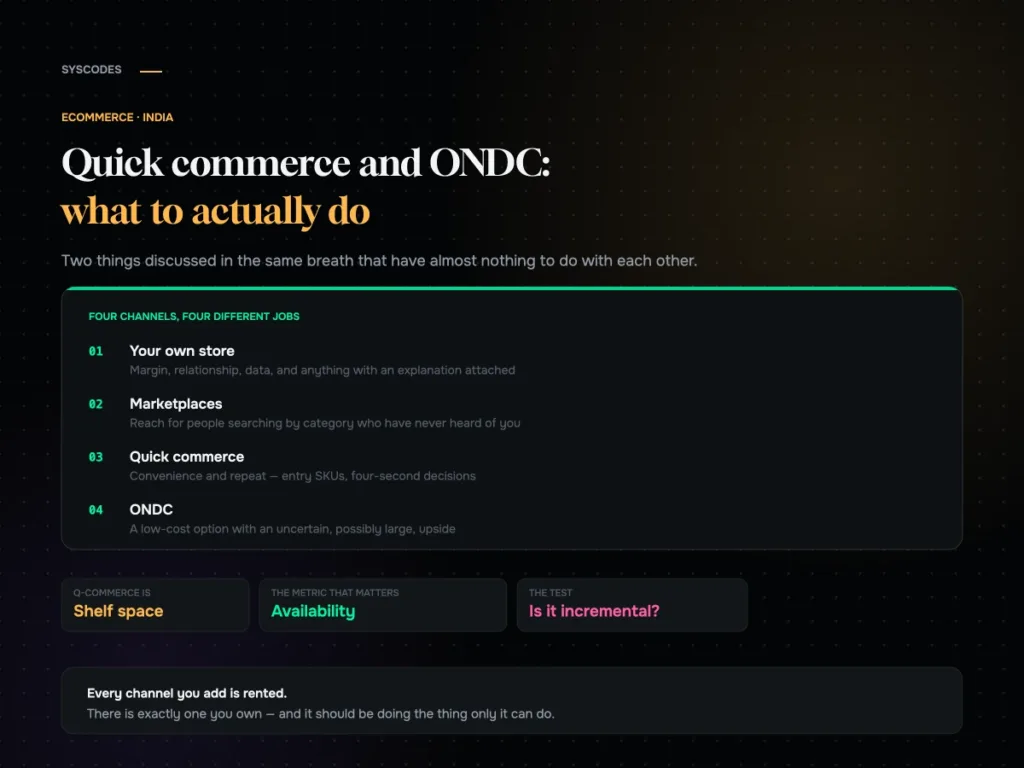
Quick commerce and ONDC: what a D2C brand should actually do
eCommerce

Quick commerce and ONDC: what a D2C brand should actually do

Which categories quick commerce actually works for, what listing costs, the cannibalisation test nobody runs, a realistic view of ONDC, and the channel map that holds…
21 Aug 202612 min read
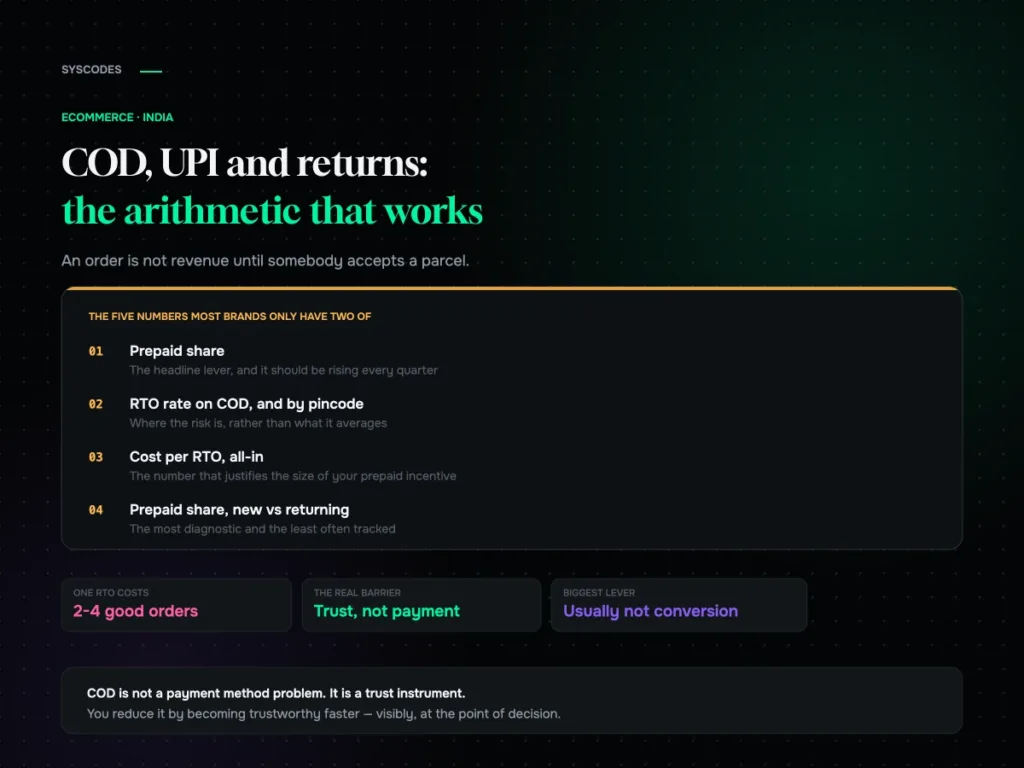
COD, UPI and returns: Indian D2C economics that actually work
eCommerce

COD, UPI and returns: Indian D2C economics that actually work

What a refused COD parcel really costs, the five numbers to measure, nine levers for prepaid share and RTO in the order we would pull them,…
21 Aug 202612 min read
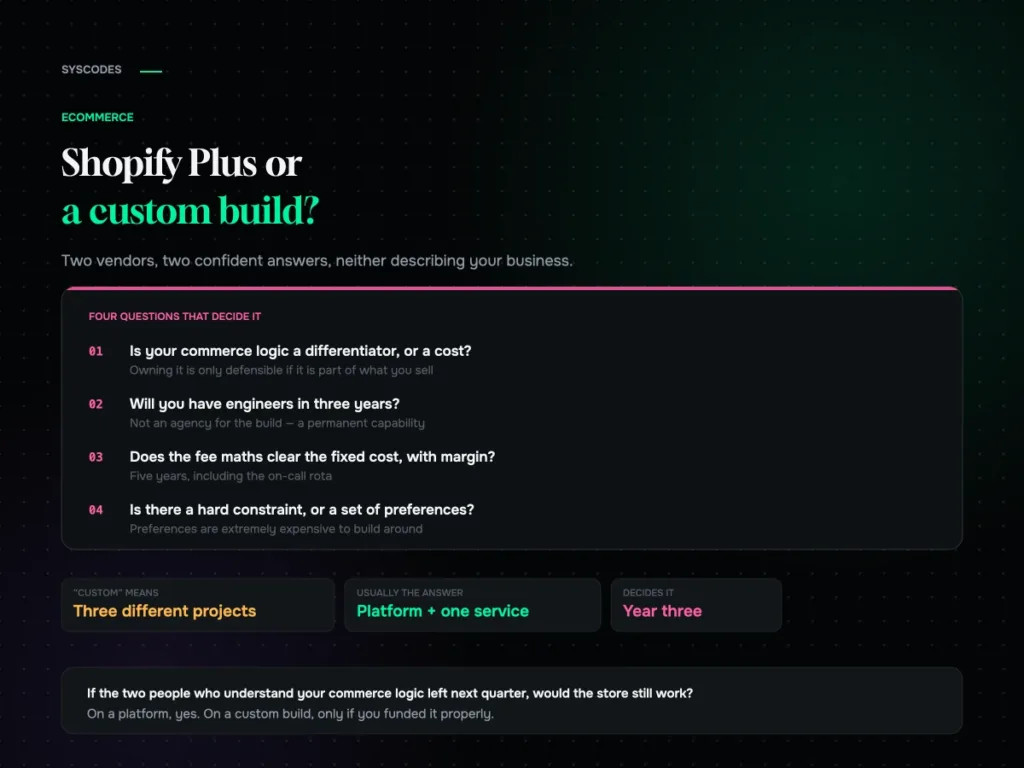
Shopify Plus versus a custom build: how to decide
eCommerce

Shopify Plus vs a custom build: how to actually decide

What an enterprise commerce plan actually buys, the three boundaries where it stops, the four questions that decide a custom build, and the middle option that…
21 Aug 202612 min read
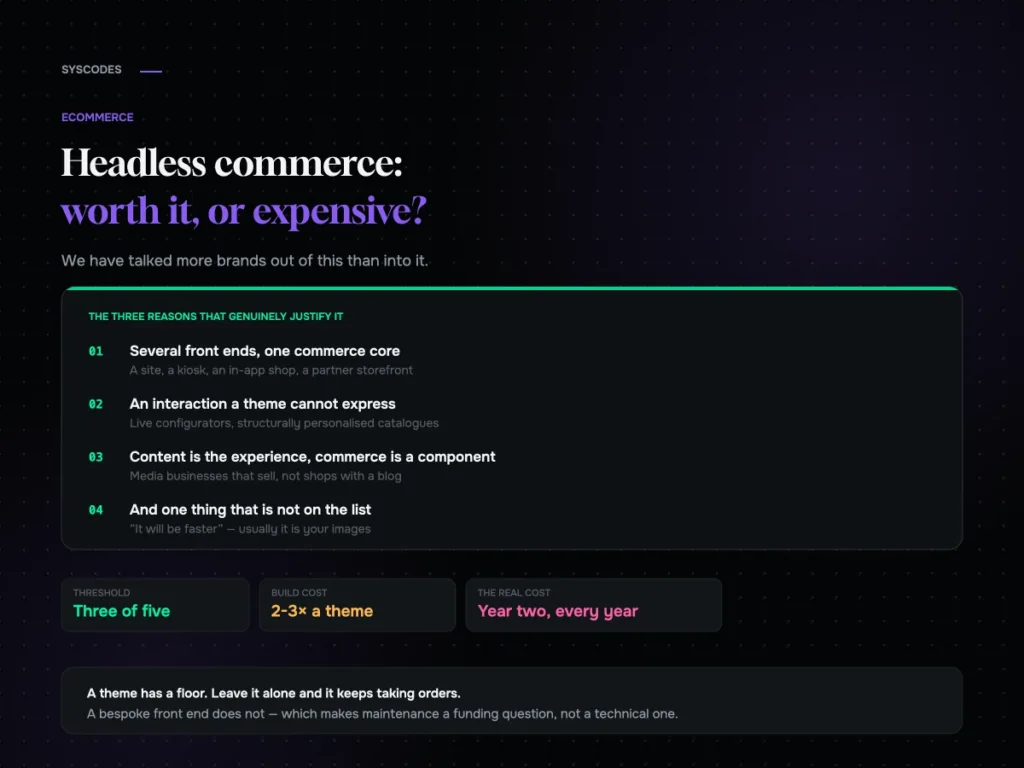
Headless commerce: when it is worth it and when it is an expensive mistake
eCommerce

Headless commerce: when it is worth it, when it is an expensive mistake

The honest threshold for headless commerce: the three reasons that justify it, the five-question test, what you take on that used to be included, and the…
21 Aug 202612 min read
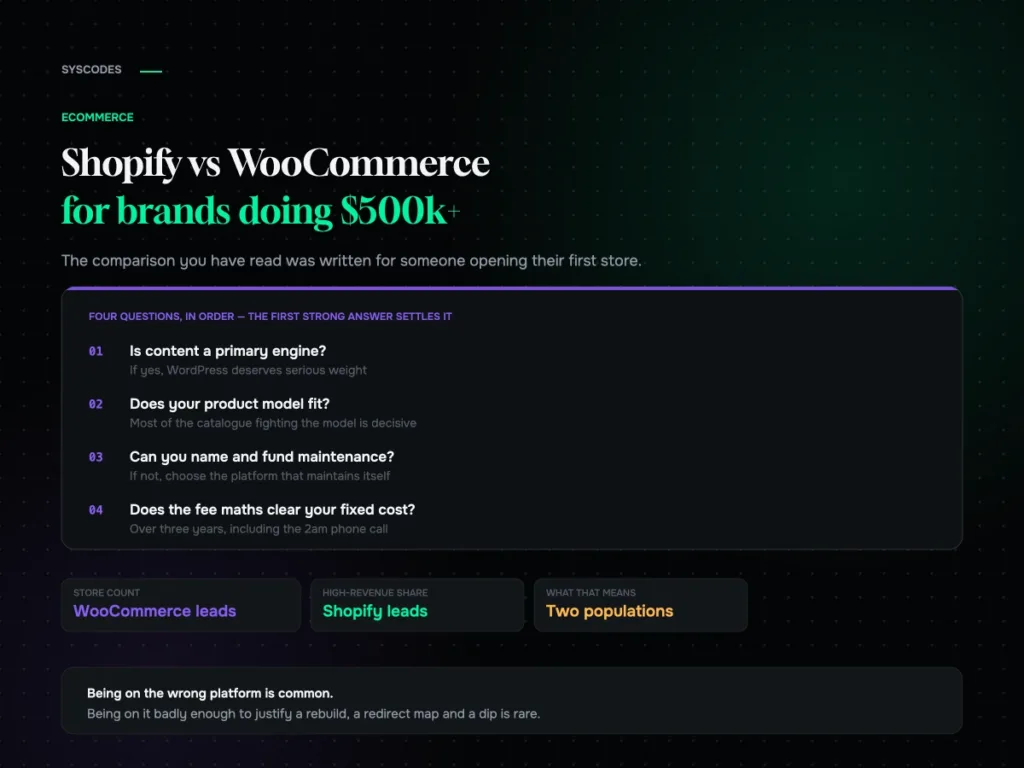
Shopify vs WooCommerce for brands doing $500k or more
eCommerce

Shopify vs WooCommerce for brands doing $500k+

A Shopify vs WooCommerce comparison written for stores at scale: checkout control, the cost curve, who maintains it, dependency shape, and the five claims that do…
21 Aug 202613 min read
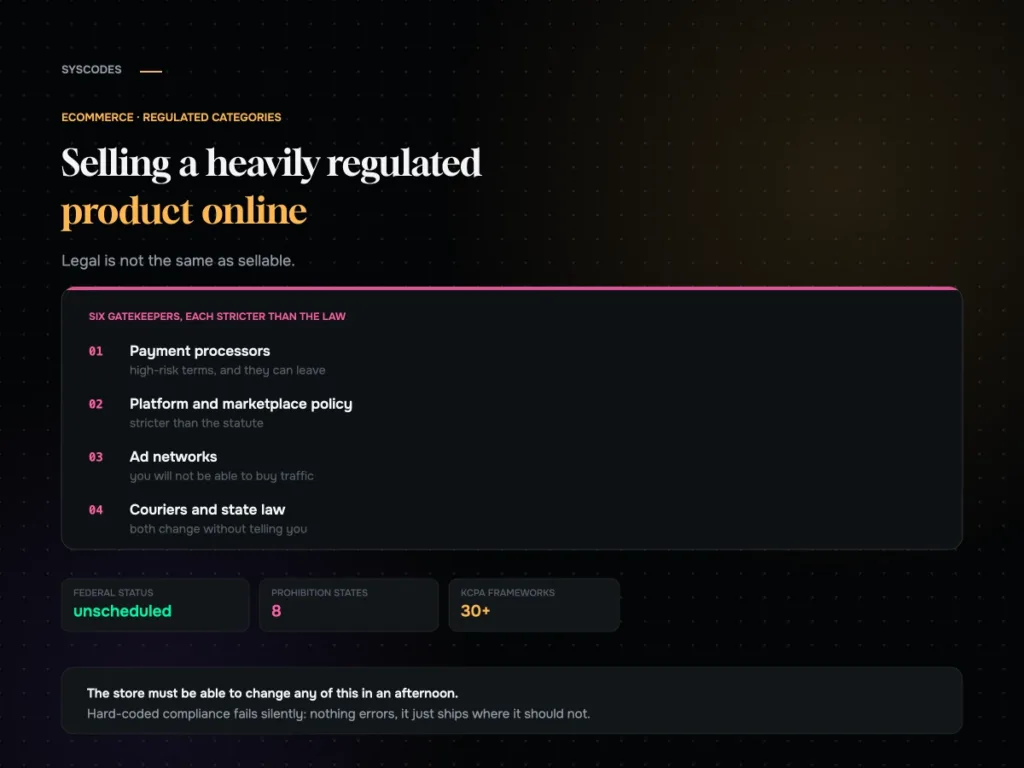
Selling a heavily regulated product online: six gatekeepers, each with a policy stricter than the law
eCommerce

Selling a heavily regulated product online: what actually stops you

Payment processor redundancy, state-level restriction as a data model, what you cannot say in product copy, and why acquisition inverts when you cannot buy traffic.

21 Aug 202612 min read
Question about your project? Tell us in 30 seconds — a senior lead replies.