Home/Blog/Migration & Replatforming
Migration & Replatforming · 11 min read

What replatforming actually costs

Four agencies, four numbers, no overlap — because they are quoting four different projects. Here is the shape of the invoice, the lines that move it, and the costs that never appear on a quote at all.
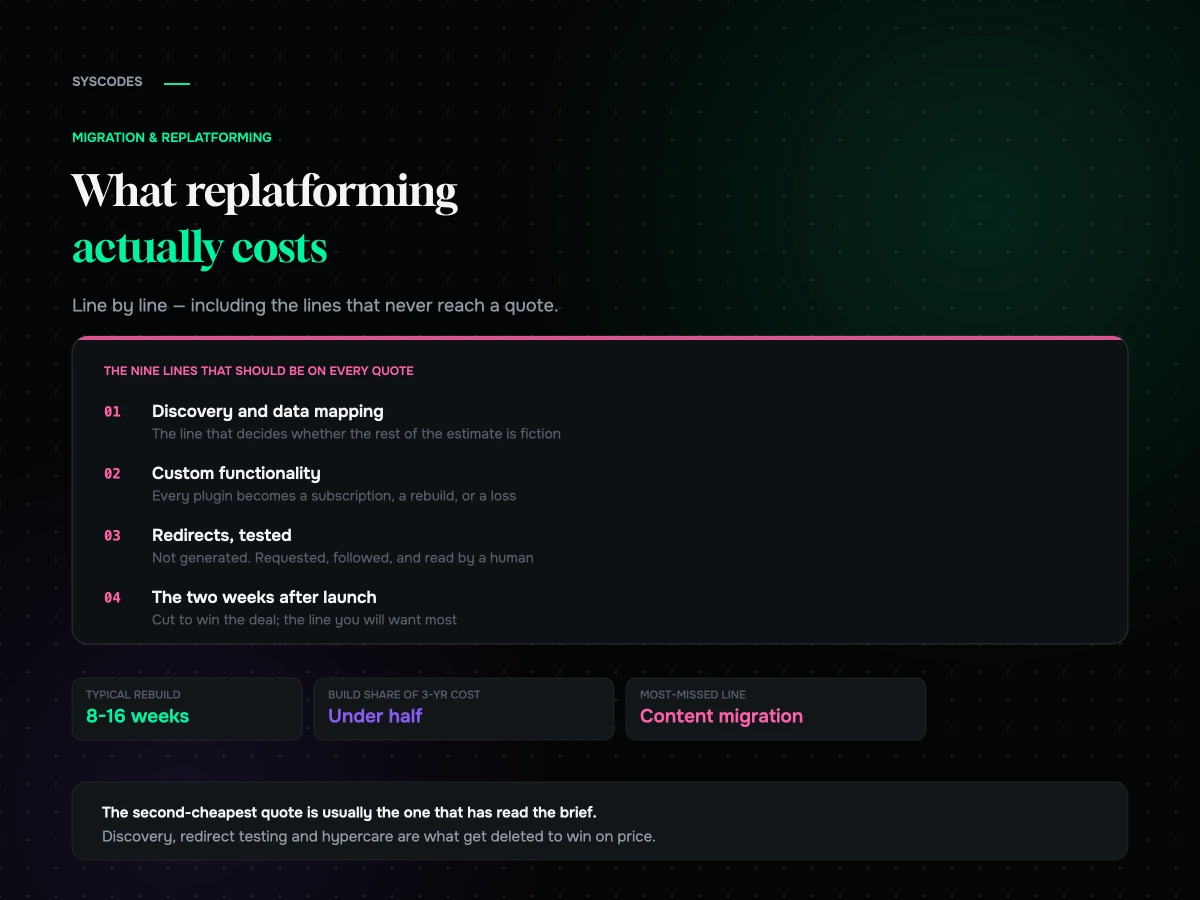
What replatforming actually costs, line by line
S
Sayan SahaUpdated August 2026 · 11 min read

Ask four agencies to quote the same replatform and you will get four numbers that do not overlap: £16,000, $48,000, ₹9,00,000 and $260,000. Nobody is lying. They are quoting four different projects, because the brief did not contain enough information to tell them apart.

That is the real problem with replatforming budgets. It is not that prices vary — every service business has a range. It is that the single word “replatform” covers a job that can honestly take three weeks or eighteen months, and no published price list distinguishes between them. So brands compare a number against a number, pick the low one, and discover in month three that the two quotes were describing different amounts of work.

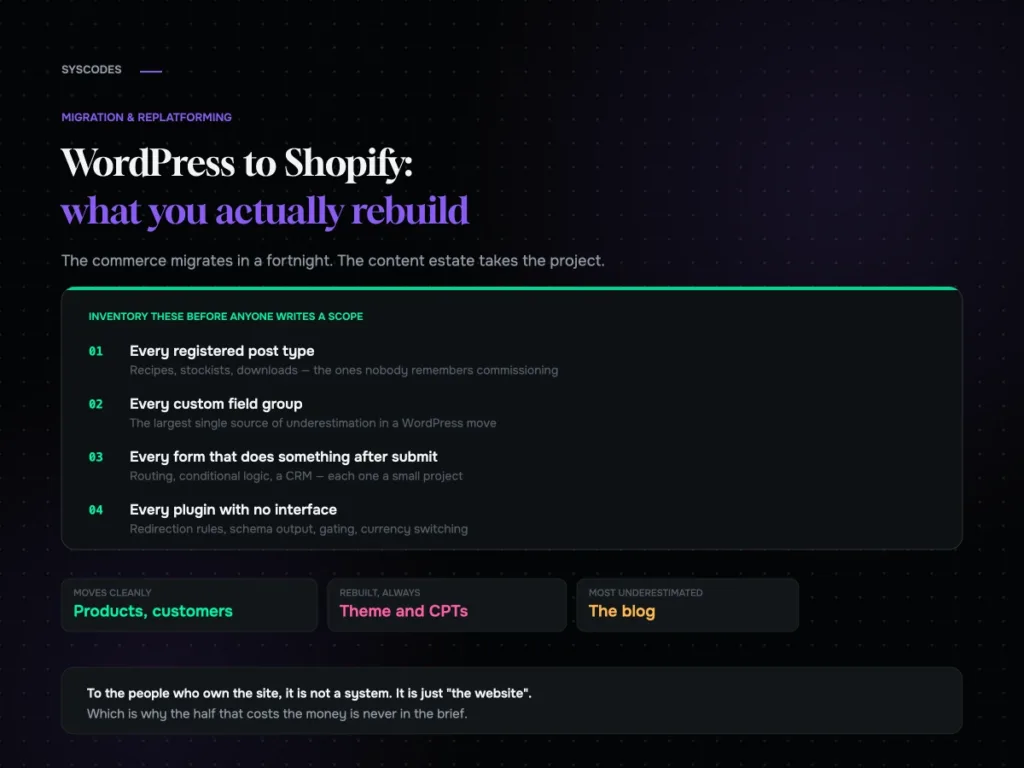
We have moved stores in both directions — WooCommerce to Shopify, WordPress to Shopify, Shopify back to WooCommerce, and a few Magento estates that should have been retired years earlier. What follows is the shape of the invoice rather than a single number: what the lines are, which ones move, and which costs never appear on a quote at all but land on your P&L anyway.

The three different projects hiding behind one word

Before any line item makes sense, work out which of these you are actually buying. Nearly every replatform is one of three shapes.

A lift. The catalogue is simple, the storefront is close to a stock theme, there are two or three integrations, and the business is happy to accept the new platform’s defaults. Data goes across, a theme gets configured and lightly customised, redirects get mapped, you launch. Three to six weeks. This is the cheapest honest version of the job and it is more common than agencies admit.

A rebuild. The catalogue needs restructuring to fit the new platform’s data model, there is custom functionality that has to be reproduced or replaced, several integrations need rewiring, and the storefront is being designed rather than configured. Eight to sixteen weeks. This is where most funded D2C brands land, and it is the band where quotes diverge most wildly.

A programme. ERP in the middle, multiple regions or currencies, B2B pricing alongside D2C, a content estate in the thousands of URLs, and four internal teams with opinions. Six months and up. Real, but rare, and if you are reading a blog post to size your budget you are probably not in this band.

The uncomfortable part: the brief you send out usually reads the same regardless of which one you are in. “We are on WooCommerce with about 400 products and want to move to Shopify” describes all three.
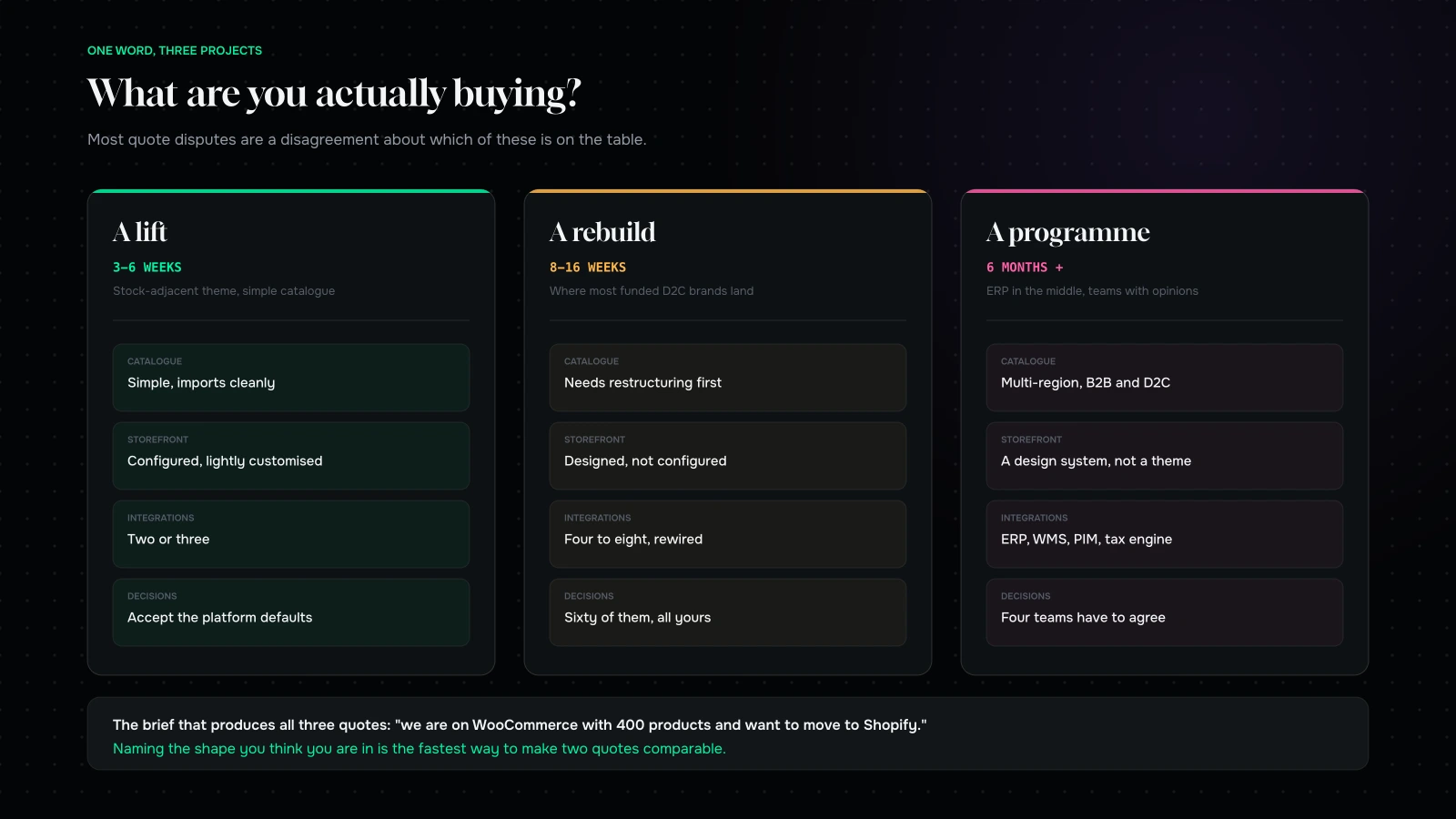
Three replatforming project shapes with typical duration and what drives each one
A lift, a rebuild and a programme are different products. Most quote disputes are really disagreements about which one is being bought.

What is actually on the quote

Almost every replatform quote, however it is presented, resolves to the same nine lines. Reading a quote well means finding all nine — the ones that are missing are the ones that will come back as a change order.

LineWhat it coversShare of a typical rebuild
Discovery and data mappingAudit, field-by-field mapping, decisions about what does not travel5–10%
Catalogue migrationProducts, variants, collections, media, metafields8–15%
Storefront designTemplates designed for the new platform, not ported10–20%
Storefront buildTheme development, components, responsive work20–30%
Custom functionalityRebuilding what plugins used to do10–25%
IntegrationsERP, 3PL, accounting, CRM, email, reviews, search5–20%
Content migrationPages, blog, landing pages, media, internal links3–10%
Redirects and SEOCrawl, mapping, testing, metadata migration3–8%
QA, launch and hypercareCross-device testing, cutover, two weeks of watching8–12%

The percentages matter more than the total. If one line is missing from a quote entirely, the agency has either absorbed it or has not seen it yet, and only one of those is good news. Integrations at zero percent means nobody has asked what your warehouse runs. Content migration at zero percent usually means somebody on your team is about to spend three weeks copying pages by hand.

Two lines are worth arguing about specifically. Discovery looks like the easiest thing to cut and is the one that decides whether the rest of the estimate is fiction. Hypercare — the fortnight after launch — is the line that gets deleted to win the deal and the one you will want most.

What moves the number, in order

Catalogue size is the number every brief leads with and it is nowhere near the top of the list.

Catalogue complexity, not count. Five hundred simple products is a smaller job than forty configurable ones. A t-shirt in five sizes and four colours is twenty variants and a solved problem. A made-to-order product with fabric, lining, monogram, length and a lead-time rule is a modelling exercise that has to happen before a single row is imported. When we rebuilt a handloom catalogue the products themselves were not the work — deciding how they should be described was.

Custom functionality. Every behaviour your current store has that the new platform does not ship resolves to one of three outcomes: an app subscription, a bespoke rebuild, or a decision to live without it. Each one needs a human to make a call, and the calls are what take time. A store with fourteen plugins doing real work is not a bigger import; it is fourteen small projects.

Integrations. Each system that talks to your store is its own mini-project with its own credentials, its own field mapping, its own test cycle and usually its own vendor who takes four days to answer email. Two integrations is a line item. Seven is a phase.

Content depth. A brand with 40 pages migrates in a couple of days. A brand with 300 blog posts, embedded media, and internal links pointing at URLs that are about to change is a fortnight of careful work, or a fortnight of sloppy work followed by six months of broken links.

Decision latency. This is the one nobody prices and it moves budgets more than any technical factor. If a question takes your team four days to answer, and a rebuild contains sixty questions, the calendar and the invoice both expand. The fastest projects we run are not the simplest ones. They are the ones with a single named decision-maker who replies the same day.

The lines that never make it onto a quote

The quote is the smaller half of the number. These are the costs that arrive anyway.

App subscriptions. Functionality that used to be a one-off plugin purchase becomes a monthly bill for as long as you trade. Subscriptions, bundles, advanced search, reviews, loyalty, back-in-stock, upsells, page building — each somewhere between $15 and $300 a month, and stores routinely finish a migration carrying eight of them. Add three years of that up before you compare platforms, because $400 a month is $14,400 over the life of the build.

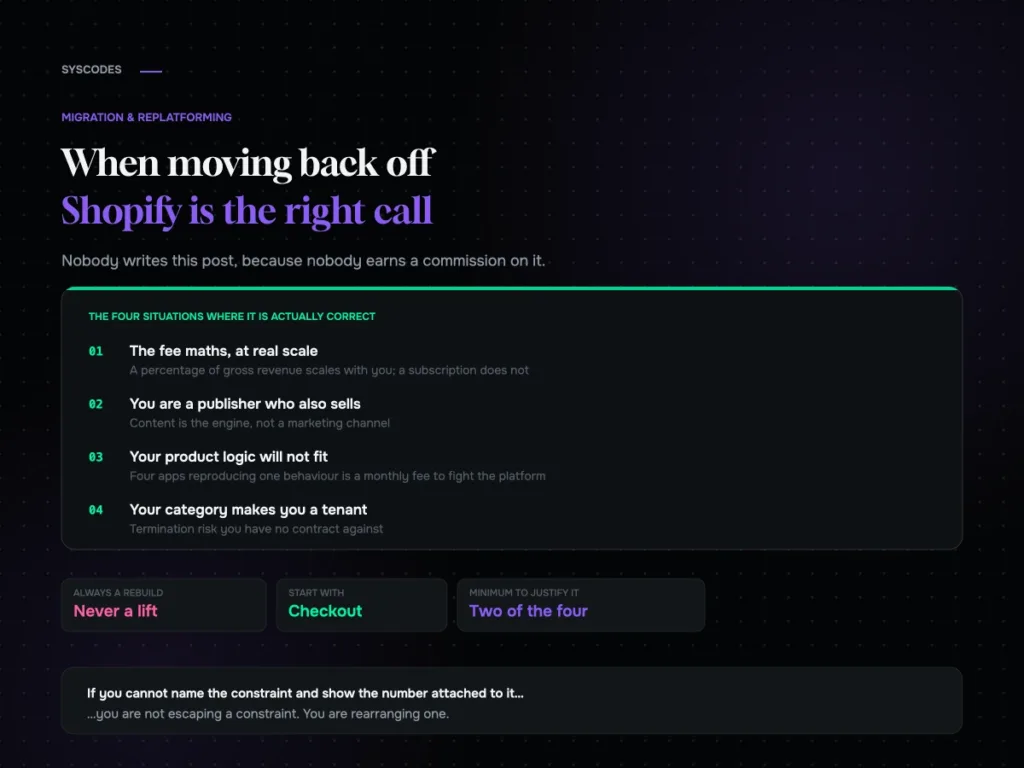
Transaction fees. If you are not using the platform’s own payment provider, expect an additional cut on every order. On $2M of revenue, a fraction of a percent is a developer’s salary. This is also the single most common reason a large store eventually looks at moving back.

Staff time. Your merchandiser, your customer service lead and your ops person all stop doing their jobs for a while — first to answer the agency’s questions, then to relearn their tools. Nobody puts this on a spreadsheet and it is often the largest hidden line in the whole project.

The content freeze. Most brands stop shipping campaigns for the last three or four weeks before launch because nothing should change while data is being migrated. That is a quarter of a trading month with no new landing pages. Price it as revenue, not inconvenience.

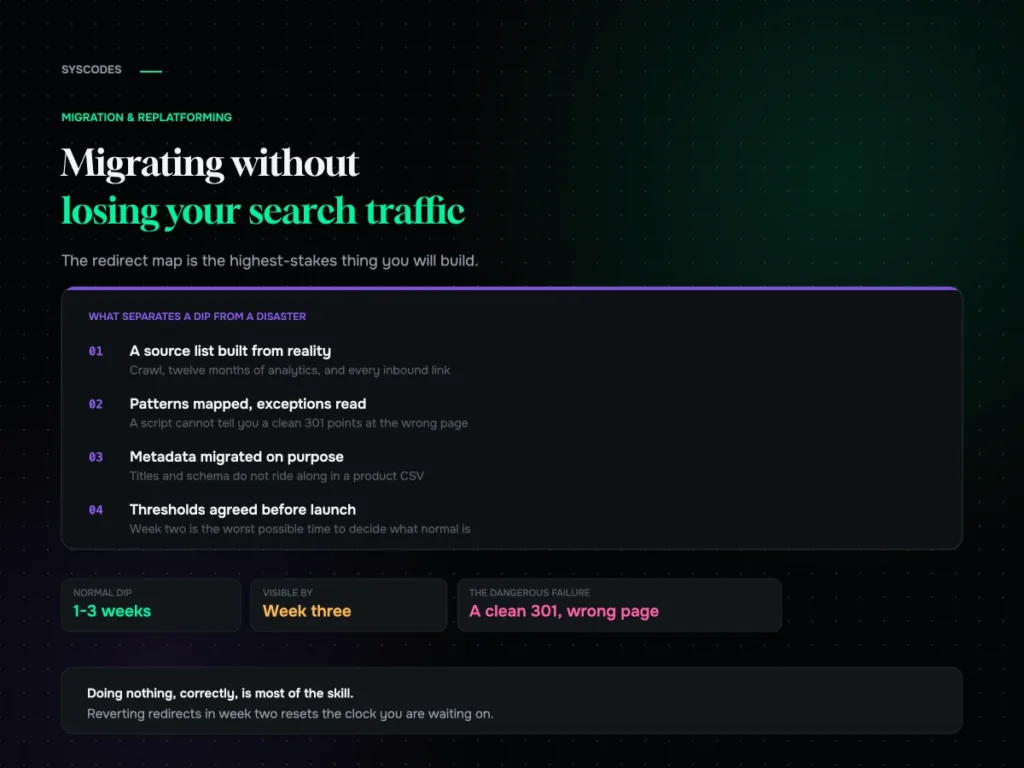
The dip. Organic traffic falls for one to three weeks after a well-executed migration while search engines recrawl. Budget for it, or at least tell the board it is coming, because being surprised by a normal dip causes expensive panic decisions. We wrote up what a healthy dip looks like against a broken one — the difference is visible by week three and invisible before it.

Change orders. Every replatform generates some. The question is whether they are discoveries or omissions. A quote that priced discovery properly produces few; a quote that skipped it produces many, and they arrive when you have no leverage left.
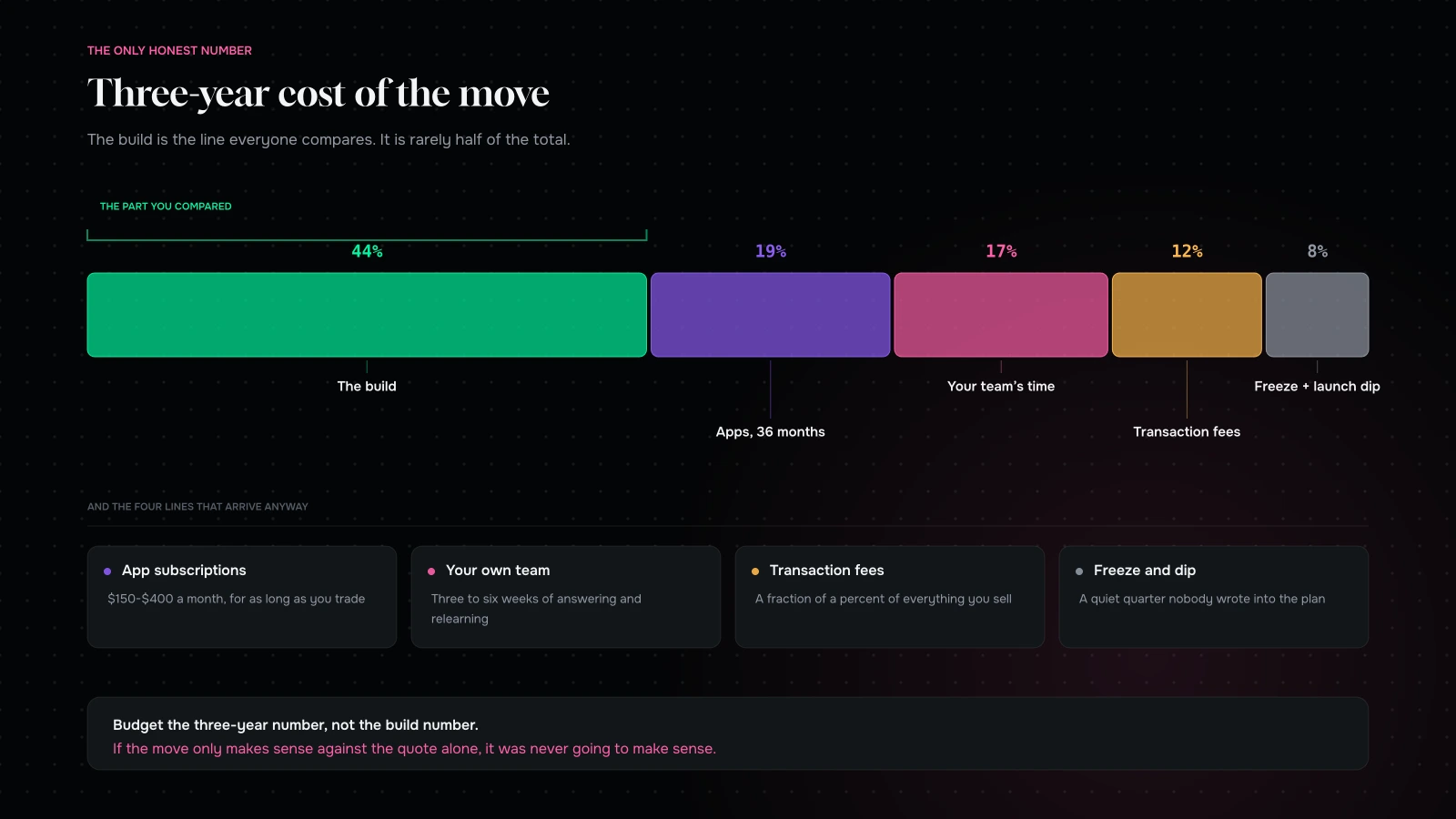
Three-year total cost of a replatform showing build, apps, transaction fees, staff time and the launch dip
The build is usually less than half of what the move actually costs over three years.

Why the cheap quote costs more

There is a reliable pattern to how a low quote becomes an expensive project, and it is not incompetence. It is arithmetic.

To win on price against a properly-scoped bid, something has to come out. What comes out is almost always discovery, content migration, redirect testing, and hypercare — because those four are the least visible to a buyer comparing documents. The theme still gets built. The products still import. The site still launches, and it looks fine.

Then the bill arrives in a different currency. Custom fields nobody mapped turn into a month of manual data entry by your own team. A redirect map that was generated but never tested costs organic revenue for two quarters, which is how Gud Tonics ended up with us after somebody else’s migration. Functionality that was quietly dropped comes back as a change order at a rate that no longer has to be competitive, because you are four months in and not going anywhere.

We have inherited enough of these to say it plainly: the second-cheapest quote is usually the one that has read the brief.

How to compare two quotes that look nothing alike

Most brands try to compare totals, which is the only comparison that carries no information. Do these five things instead and the differences resolve in about an hour.

  1. Map both quotes onto the nine lines above. Anything with no home is either missing or bundled — ask which.
  2. Ask what happens to your custom fields. Specifically: name three pieces of product data that live outside the standard fields, and ask each agency where those end up. The quality of the answer separates the field faster than any other question.
  3. Ask who builds and who tests the redirect map, and what “tested” means. If the answer does not include requesting every historic URL and checking the destination, it is not testing.
  4. Ask what is excluded. Good agencies have a list ready. If nothing is excluded, nothing has been scoped.
  5. Ask what happens in the two weeks after launch, and whether that is in the price or hourly.

If a quote survives those five questions, the number on it means something. If it does not, the number is a deposit.

What we would cut first

If the budget genuinely will not stretch, some things are safer to cut than others. In rough order of what we would drop:

  • Design ambition on secondary templates. Your product page and cart deserve real attention. Your “shipping information” page does not.
  • Day-one feature parity for things almost nobody uses. Pull the analytics. Features used by two percent of sessions can wait for phase two, or forever.
  • Non-critical integrations. Anything a person can do manually for a month at low volume can go in phase two.
  • Custom rebuilds of app-shaped problems. Take the app subscription now, build it properly when the volume justifies it.

And what we would not cut, in any circumstances: discovery, redirect mapping and testing, catalogue data quality, and the two weeks after launch. Those four are the difference between a migration and an incident.

India, the UK and the US: the same project, a different invoice

Both of our markets ask this and neither likes the answer, so here it is directly.

The same rebuild costs materially less delivered from India than from a London or New York agency, and the gap is not a quality gap — it is a cost-of-delivery gap. What that means practically is that an Indian-market budget buys more senior attention per pound than the same budget buys in the UK, and that a US brand paying Indian rates is usually buying a team, not a discount.

What does not change with geography: the number of decisions in the project, the number of integrations, and how long your own team spends answering questions. Those are properties of your business. This is why we are sceptical when a brand tells us they saved sixty percent by going offshore and then describes a project that took nine months. They did not buy a cheaper project. They bought a slower one.

For Indian D2C brands specifically, one line moves that international brands do not carry: COD and returns tooling. Address validation, RTO scoring, partial-prepaid flows and courier logic are real build items here and effectively absent from a US brief. Budget for them explicitly rather than discovering them in week ten.

Where the hours actually go inside a build

Buyers picture a replatform as design and code. Look at a finished timesheet and it rarely is.

On a typical rebuild, the largest single block is not front-end development — it is data and decisions. Mapping fields, chasing the answer to “what should happen to this product’s spec sheet”, running an import, finding forty rows that failed, working out why, running it again. It is unglamorous, it is invisible in a demo, and it is where projects overrun.

The second block is testing, and it is bigger than people expect because a store has more states than a website. A product that is out of stock in one variant. A discount that stacks with a shipping threshold. A returning customer with a saved address in a country you no longer ship to. Checkout on an old Android phone on a bad connection. None of that shows up in a design review and all of it shows up in your support queue.
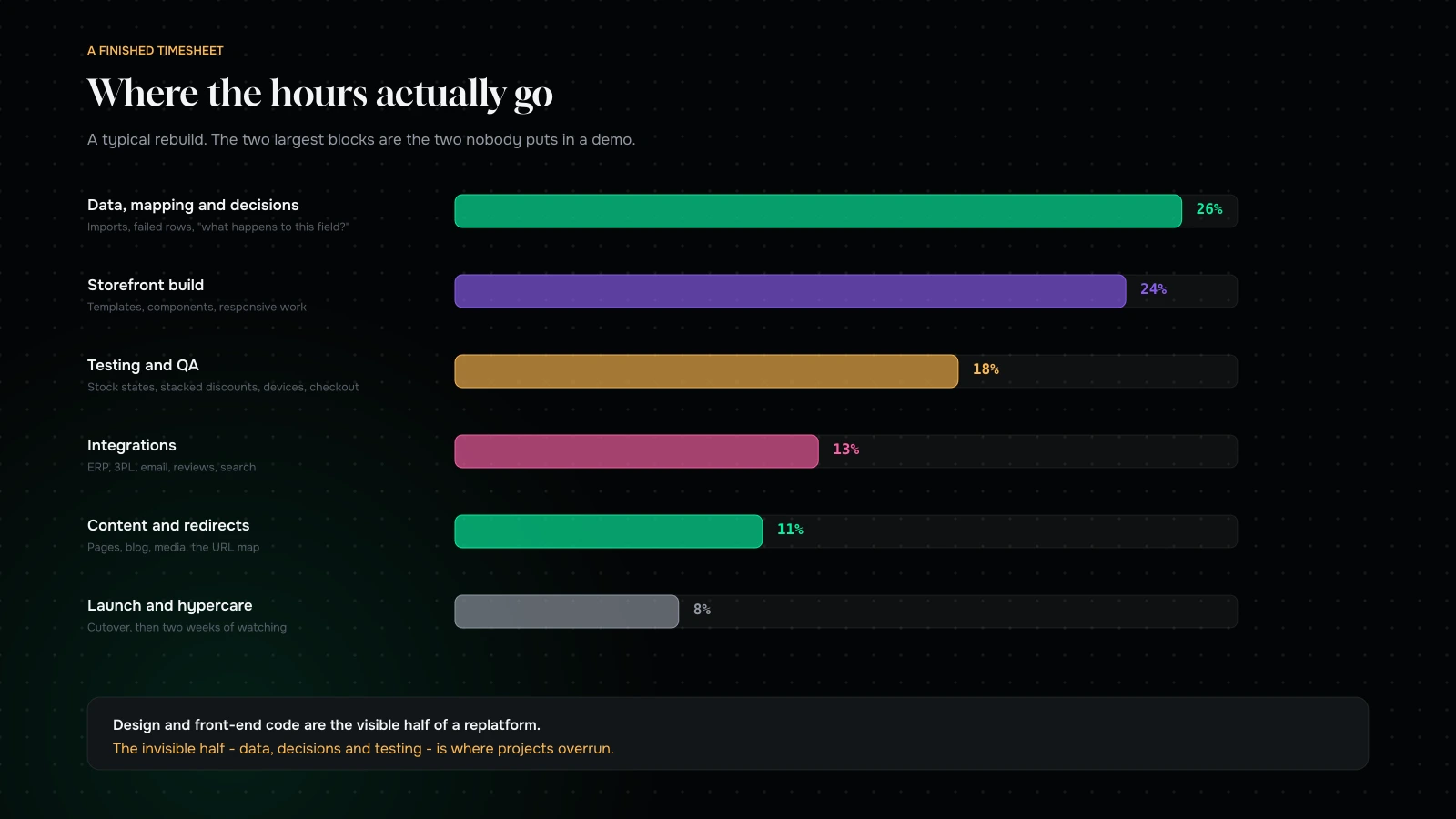
Where the hours go on a typical replatform: data and decisions, storefront build, testing, integrations, content, launch
Design and front-end code are the visible half. The invisible half is what overruns.

The practical consequence for your budget: an agency that quotes mostly build hours with a thin testing line has either not done this before or is expecting you to test. Ask which.
Phasing, and what a two-stage move buys you

There is a middle option between the lift and the rebuild that almost nobody offers, and it is the right answer more often than either.

Stage one moves the store — data, a clean but restrained storefront, redirects, integrations, launch. Stage two, starting six to eight weeks later, does the design ambition and the conversion work, on a platform that is now live and generating data you could not have had before.

Two things make this cheaper rather than just slower. You stop paying to rebuild functionality you turn out not to need, because six weeks of real behaviour tells you what nobody uses. And you decouple the riskiest day of the project — cutover — from the most opinion-heavy part of it, so a delayed design decision no longer holds a migration hostage.

The trade-off is real and worth stating: you launch on something less exciting than the deck promised, and somebody senior has to hold their nerve for six weeks. Brands with a strong internal champion do well with this. Brands where the migration is a board-level showpiece usually cannot.

What it comes down to

A replatform is not one price because it is not one project. Before you can compare numbers you have to know whether you are buying a lift, a rebuild or a programme — and most briefs do not say, so most quotes guess.

The honest way to budget is to build the three-year number, not the build number: the quote, plus apps, plus fees, plus your own team’s time, plus one quiet quarter. If the move still makes sense against that, it will make sense afterwards too. If it only makes sense against the build number alone, it was never going to.

And if you run that arithmetic and the answer is that your problem is a theme, an app pile-up or a checkout rather than a platform, fix it where you are. It is cheaper, it is faster, and you keep the result whichever platform you end up on.

Want a real number rather than a range? Send us your store URL and a rough sense of your catalogue through the contact form. We will come back with which of the three shapes you are in, the three lines most likely to move, and what we would cut if the budget were tighter than the brief. If we think you should not move at all, we will say that — it is a smaller invoice and a better outcome.

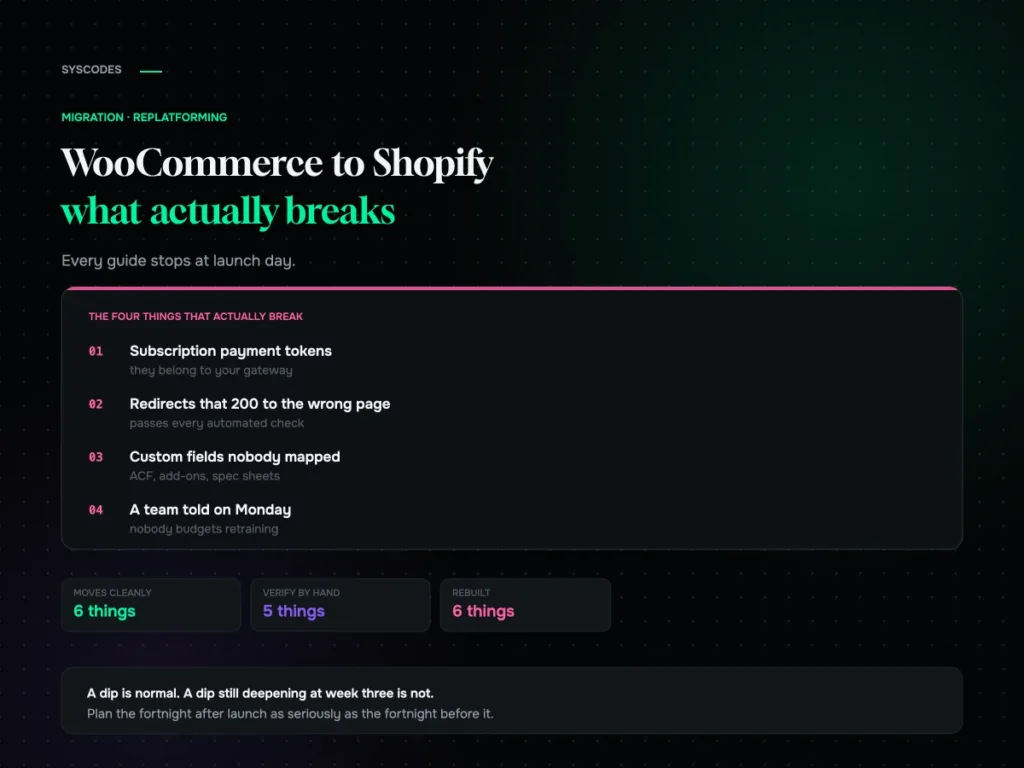
You can also read what actually breaks in a WooCommerce to Shopify migration, or look at the rest of our recent work.

Before you sign anything

We would rather scope it honestly than win it cheaply.

Send us your store URL and a rough sense of your catalogue. We will come back with which of the three shapes you are in, the three lines most likely to move, and what we would cut if the budget were tighter than the brief.

If we think the honest answer is that you should not move at all, we will say that. It is a smaller invoice and a better outcome.

NDA on request · you will hear back from Sayan or a senior lead, never a bot
Question about your project? Tell us in 30 seconds — a senior lead replies.