The single most common reason a web project goes badly is not a bad agency. It is a brief that was not specific enough to be quoted, so three agencies quoted three different projects, and the client picked the cheapest description of a job nobody had scoped.
Briefs are hard to write because they ask you to be precise about things you have not decided yet. That is uncomfortable, so most briefs retreat into adjectives — modern, clean, user-friendly, premium — none of which can be priced.
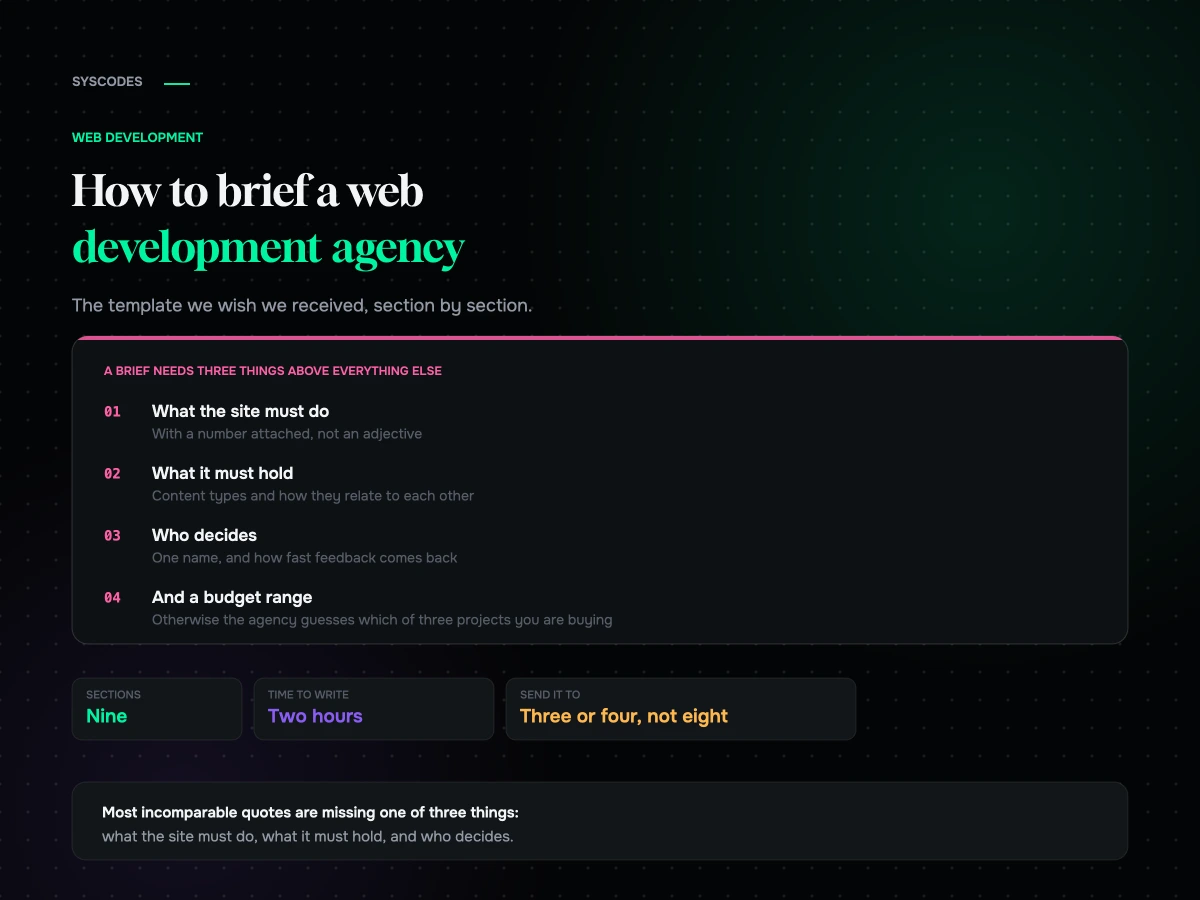
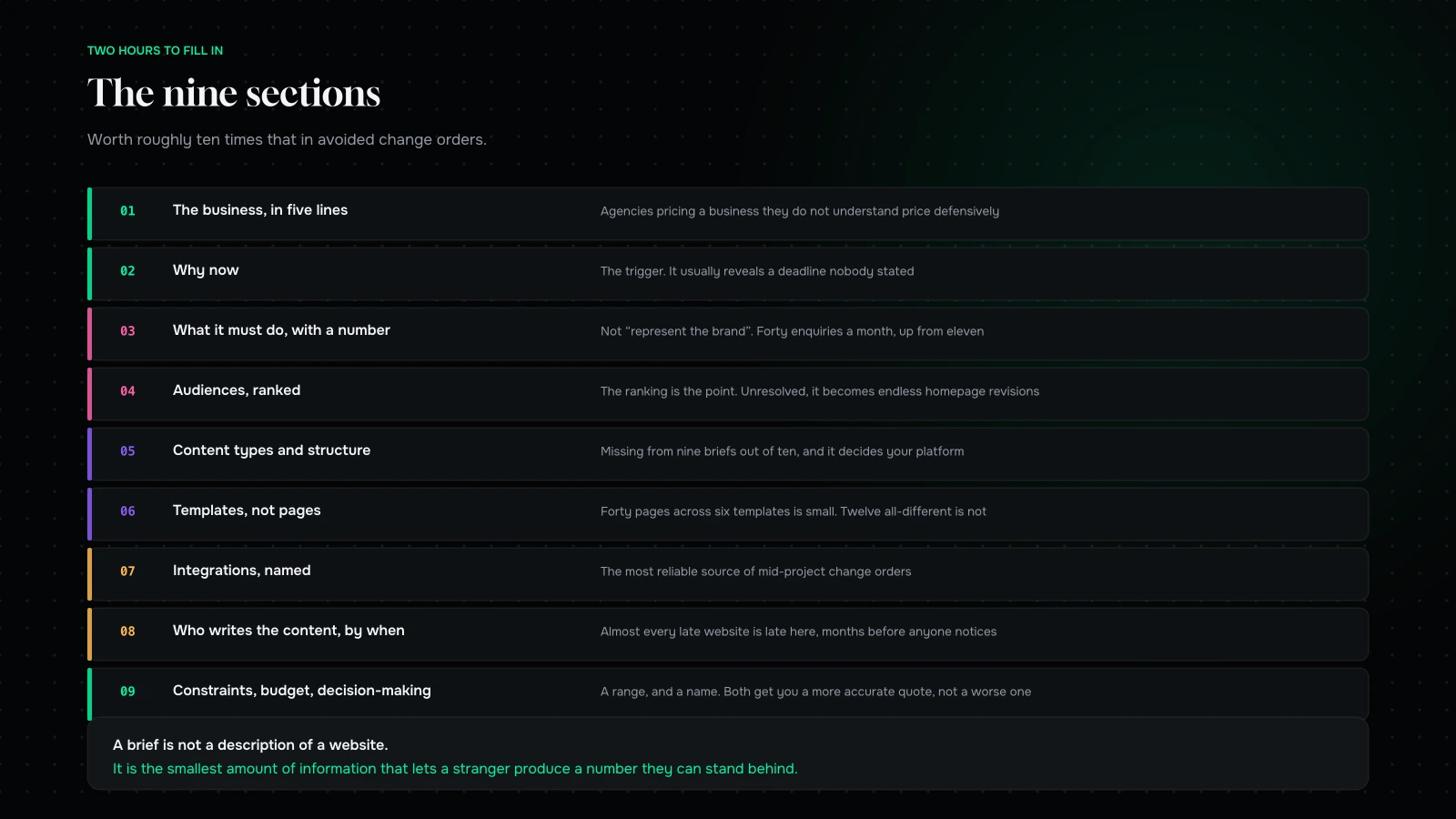
This is the template we wish we received, section by section, with what each one is actually for. It takes about two hours to fill in, and it is worth roughly ten times that in avoided change orders.
What a brief is actually for
Not to describe the website. To let somebody who has never met you produce a number they can stand behind.
That means it needs three things above everything else: what the site must do, what it must hold, and who decides. Almost every incomparable quote we have seen was missing one of those three.
The corollary is that a brief does not need to specify solutions. You are not designing the site; you are describing the problem well enough that somebody good can propose one. A brief that arrives with a wireframe attached has usually removed the most valuable thing the agency could have contributed.
The template

1. The business, in five lines
What you do, who you sell to, how you make money, roughly how big you are, and what has changed recently. Agencies pricing a site for a business they do not understand will price defensively, which means high.
2. Why now
The trigger. A rebrand, a funding round, a new market, a site that has stopped working, a platform being retired. This is more useful than it sounds — it tells the reader what actually has to be true at the end, and it usually reveals a deadline nobody stated.
3. What the site must do, with a number
The most important section, and the one most often written as a feeling.
Not “represent the brand properly”. Something like: generate forty qualified enquiries a month, up from eleven. Or: let the sales team send a specific proof page to a specific kind of buyer. Or: stop the support team answering the same six questions.
A brief with a number in this section produces proposals about outcomes. A brief without one produces proposals about page counts and mood boards.
4. Audiences, ranked
List everyone the site serves — customers, prospects, existing clients, recruits, partners, investors, journalists — and then rank them. The ranking is the point. A site that treats three audiences equally serves none of them, and the endless homepage revisions that afflict web projects are almost always an unresolved argument about this ranking.
5. Content types and structure
What kinds of thing will live on this site, and how they relate. Articles, case studies, services, people, locations, events, resources, downloads. For each, roughly what fields it needs and what it connects to.
This is the section that most changes a quote, and it is missing from nine briefs out of ten. It is also, as we argue in WordPress vs Webflow vs Wix, the thing that decides your platform.
6. Templates, not pages
Count the unique templates you think you need — homepage, service page, case study, article, contact, and so on — and estimate the number of pages of each type. Forty pages across six templates is a small job. Twelve pages that are all different is a large one, and a brief that says “about 40 pages” tells the reader neither.
7. Integrations and systems
Every system the site must talk to, named. CRM, marketing automation, booking, payments, analytics, chat, ERP, a customer portal. For each, say whether it is required at launch or later.
Unnamed integrations are the single most reliable source of mid-project change orders.
8. Content: who writes it, and by when
Be honest here, with yourself more than with the agency.
If your team is writing it, say so, and say when it will be ready. If nobody has time — which is the usual truth — say that too, and ask for it to be priced. Almost every late website is late because of content, and the lateness is decided in this section, months before anyone notices.
9. Constraints, budget and decision-making
Constraints: brand guidelines, accessibility requirements, legal or regulatory obligations, an existing platform you must stay on, a hosting arrangement you cannot change.
Budget: a range. We will return to this below, because it is the section people most want to omit.
Decision-making: who signs off, who else must be consulted, and how quickly feedback comes back. This is a genuine cost driver and stating it honestly gets you a more accurate quote, not a worse one.
Yes, put a budget in it
The usual objection is that stating a budget means the agency will spend all of it. Sometimes true, and it is still the right call, for a straightforward reason.
Without a budget, the agency has to guess which of the three tiers of website you are buying — a configured template, a designed site, or a design system — and they will guess. Half the time they guess wrong, and you spend two weeks in meetings discovering that the proposal describes a different project from the one you can afford.
A range solves this. “Between X and Y, and here is what we would prioritise if it has to be nearer X” is the single most useful sentence you can write, and it tells a good agency exactly how to shape the proposal.
If you genuinely do not know the range, say that and ask for options at two levels. That is also a legitimate brief. What is not useful is pretending you have no view when you do.
The five things that change a quote most
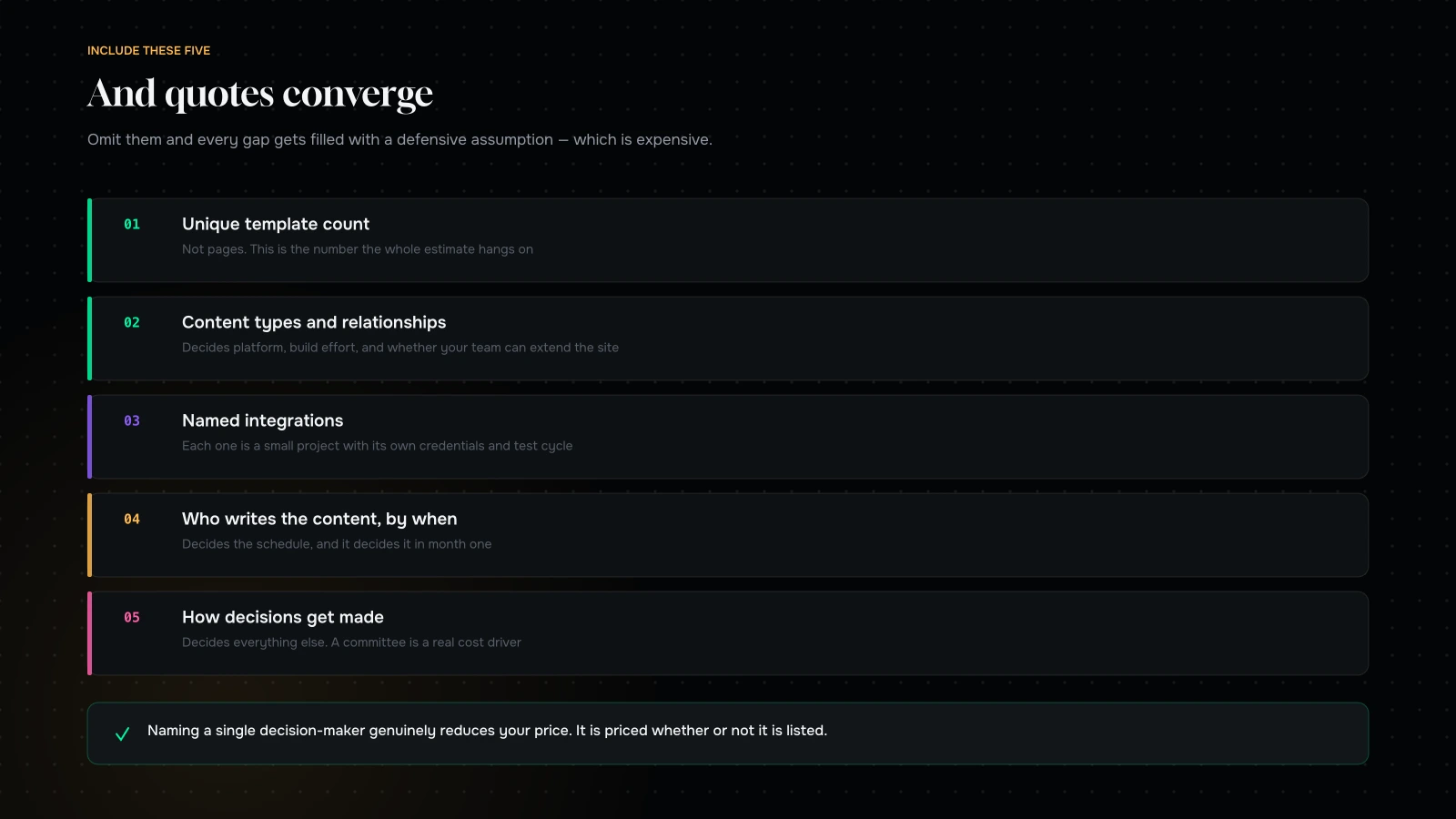
Include these and quotes converge. Omit them and you are comparing guesses.
Unique template count. Not pages.
Content types and their relationships. Decides platform, build effort and whether your team can extend the site.
Named integrations. Each one is a small project.
Who writes the content and by when. Decides the schedule.
How decisions get made. Decides everything else.
What not to put in a brief
Adjectives without referents. “Modern”, “clean”, “premium”, “user-friendly”. Show three sites you like instead, and — more usefully — say what about each one you like, because otherwise the agency guesses and usually guesses the visual style when you meant the structure.
Solutions. “We need a mega menu and a parallax hero.” Maybe. Describe the problem and let people who do this daily propose the answer; if their answer is worse than yours, that is useful information about the agency.
A wireframe, unless you have a specific reason. It anchors everybody, including you, and it removes the part of the engagement with the highest value.
A feature list copied from a competitor. They have different customers and possibly a different business model.
An unrealistic deadline with no reason attached. If the date is real — an event, a funding round, a product launch — say why, and a good agency will shape scope around it. If it is arbitrary, it will quietly cost you money.
What agencies do with your brief that you cannot see
Useful to know, because it explains why small omissions produce large price differences.
They assume the worst on anything unstated. Not out of cynicism — out of experience. An unnamed integration is priced as a hard one, an unspecified content model is priced as a complex one, and an unstated feedback process is priced as slow. Every gap in your brief is filled with a defensive assumption, and defensive assumptions are expensive.
They decide, quietly, how much they want the work. A brief that shows the client has thought about it attracts better attention and often a better price, because the perceived risk is lower. Briefs that read as a fishing exercise get template responses.
They look for the thing you have not decided yet. Experienced teams can spot an unresolved internal argument in a brief from a paragraph — usually about audience ranking or about who the site is really for. Whether they raise it before or after the contract is signed tells you a great deal about them.
They estimate the number of meetings. More stakeholders means more calls, more revisions and more reconciliation, and it goes into the number whether or not it appears as a line. This is why naming a single decision-maker genuinely reduces your price.
None of this is adversarial. It is what anybody does when asked to commit to a number with incomplete information, and the fix is entirely in your hands.
Running the process
Three or four agencies, not eight. More than four produces a great deal of work for everybody and worse decisions, because the comparison gets shallower as the pile grows.
Send the same brief to everyone, and answer questions in a way all of them can see. Agencies ask good questions; those questions are free consulting and they should not advantage only the one who asked.
Give at least two weeks. A proposal written overnight is a template with your name in it.
Meet before the proposal, not after. Half an hour of conversation improves a proposal more than any amount of written clarification, and it tells you what working with these people will feel like — which is most of what you are buying.
Do not ask for free design work. Speculative concepts tell you which agency is best at guessing without information. Ask for their thinking, their process, and examples of work in comparable situations instead.
Reading the responses

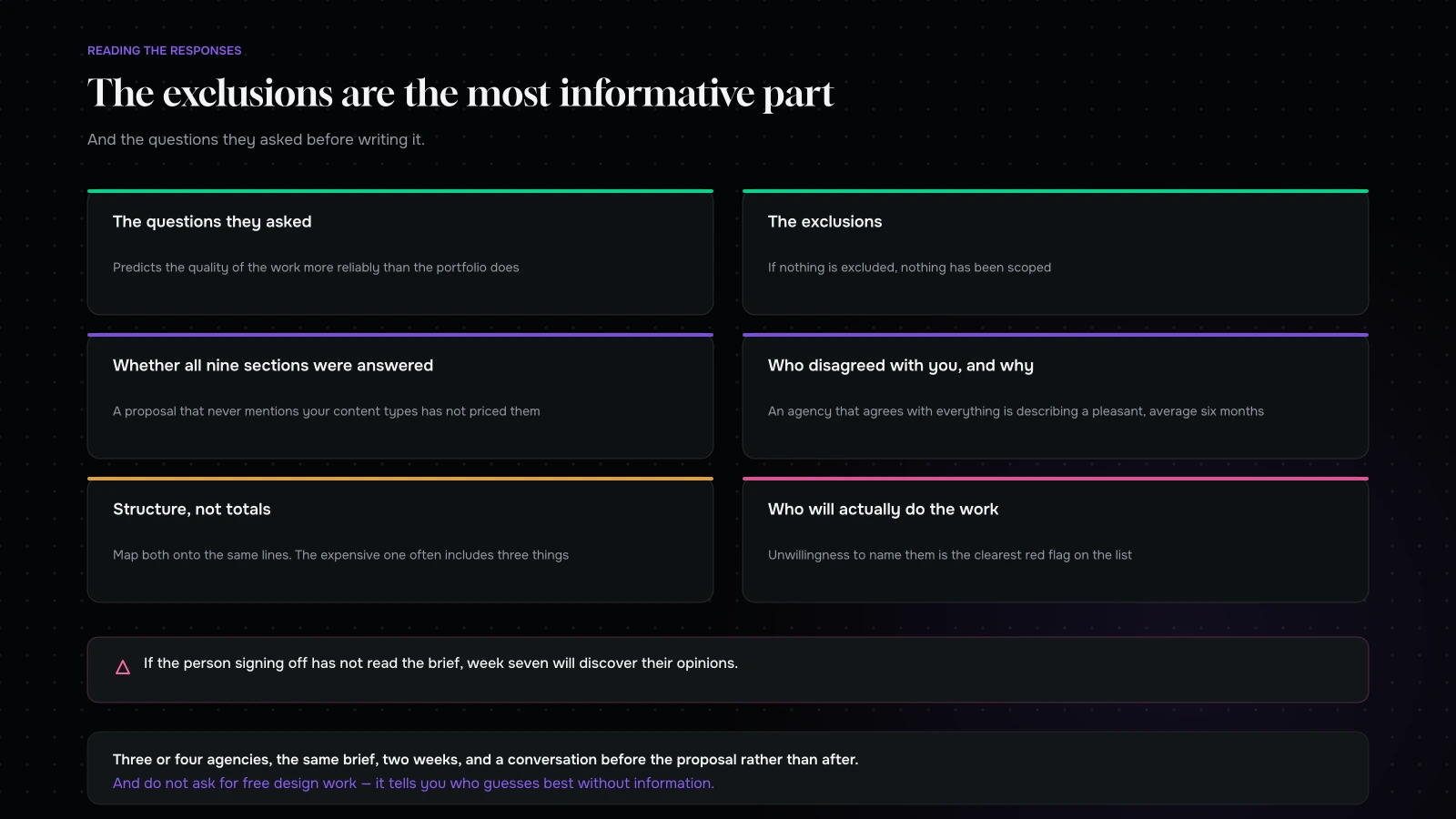
Look at the questions they asked first. The quality of an agency’s questions predicts the quality of their work more reliably than their portfolio does.
Read the exclusions. Good proposals have them. If nothing is excluded, nothing has been scoped, and everything not mentioned will be a change order.
Check that all nine of your sections were answered. A proposal that does not mention your content types has not priced them.
Notice who disagreed with you. An agency that pushes back on part of your brief, with reasons, is showing you what they will be like when it matters. One that agrees with everything is describing a pleasant six months and an average outcome.
Compare structure, not totals. Map each proposal onto the same line items. When you do, the “expensive” one often turns out to include three things the cheap one omitted.
Red flags, in both directions
From the agency: no discovery phase; no exclusions; a fixed price with no scope definition; a timeline that assumes zero feedback delay; unwillingness to name who will actually do the work; and a proposal that could have been sent to anybody.
From your side — worth naming honestly, because clients cause a good share of failed projects: no single decision-maker; feedback by committee; content promised and not delivered; scope added without budget; and a brief written by somebody who is not the person who will approve the result.
That last one is the quiet killer. If the person signing off has not read the brief, the project will discover their opinions in week seven, and everything before that will be re-done.
A worked example of section three
Because this is the section people find hardest, here is the same business writing it badly and then well.
Badly: “We need a modern, professional website that reflects who we are and generates more leads.”
Nothing in that can be priced, argued with, or measured. Every agency will read into it whatever they are good at.
Well: “We are a specialist manufacturer selling to procurement teams. Our current site produces about eleven enquiries a month and most of them are unqualified. We want forty a month, and we want the sales team to be able to send a prospect a page that answers their specific technical objection. The two objections that lose us deals are lead time and compliance certification.”
That version tells the reader what to build, what to write, what to measure, and which two pages matter most. It is not longer by much. It is specific instead of aspirational, and specificity is the whole job.
If you cannot write the good version, that is itself the finding — and it is worth spending a week on before you spend a quarter on a website.
The one-page summary to put at the top
Agencies read a lot of briefs. Put this at the front and everything after it lands better.
| Field | Yours |
|---|---|
| What the site must achieve | One sentence, with a number |
| Primary audience | One group, ranked first for a reason |
| Unique templates | A count |
| Content types | A list |
| Integrations at launch | Named |
| Who writes the content | A name and a date |
| Budget range | Two numbers |
| Decision-maker | A name |
| Deadline, and why | A date and a reason |
Nine rows. If you can fill all nine honestly, your brief is already better than most of what agencies receive, and the rest of the document is elaboration.
After you choose
Two things worth agreeing in the first week, before anyone designs anything.
A definition of done for each phase. What has to exist for design to be finished, for build to be finished, for launch to happen. Written down. Most disputes late in a project are two people holding different definitions of a word neither of them defined.
A feedback protocol. Who consolidates comments, how quickly they come back, and what happens when two stakeholders disagree. Agencies build in an assumed feedback speed; if yours is slower, either the timeline moves or corners get cut, and it is better to decide which of those consciously.
Neither takes more than an hour. Both prevent the specific failure where a project is going well until suddenly, in week nine, it is not — and nobody can point to when it changed.
What it comes down to
A brief is not a description of a website. It is the smallest amount of information that lets a stranger produce a number they can stand behind — what the site must do, what it must hold, and who decides.
Write those three properly, put a budget range in, be honest about content, and send it to three agencies with two weeks to respond. You will get comparable proposals, you will pick on substance rather than price, and the project will start with everybody describing the same job.
That last part is most of what separates a good web project from a bad one, and it costs you an afternoon.
Want a second pair of eyes on your brief? Send us the draft through the contact form and we will tell you which of the nine sections is missing and what it will cost you if you send it as it is. We will do that whether or not you want a quote from us — an unquotable brief wastes everybody’s time, including ours.
You can also read what a custom website actually costs, or five signs your website is costing you business.
Send us your draft brief and we will tell you what is missing from it.
We will point out which of the nine sections is absent, what a reader will assume in its place, and what that assumption will cost you when the proposals come back.
We will do this whether or not you want a quote from us. An unquotable brief wastes everybody’s time, including ours.
More on Web Development
Building, briefing and maintaining a website that still works in year three.

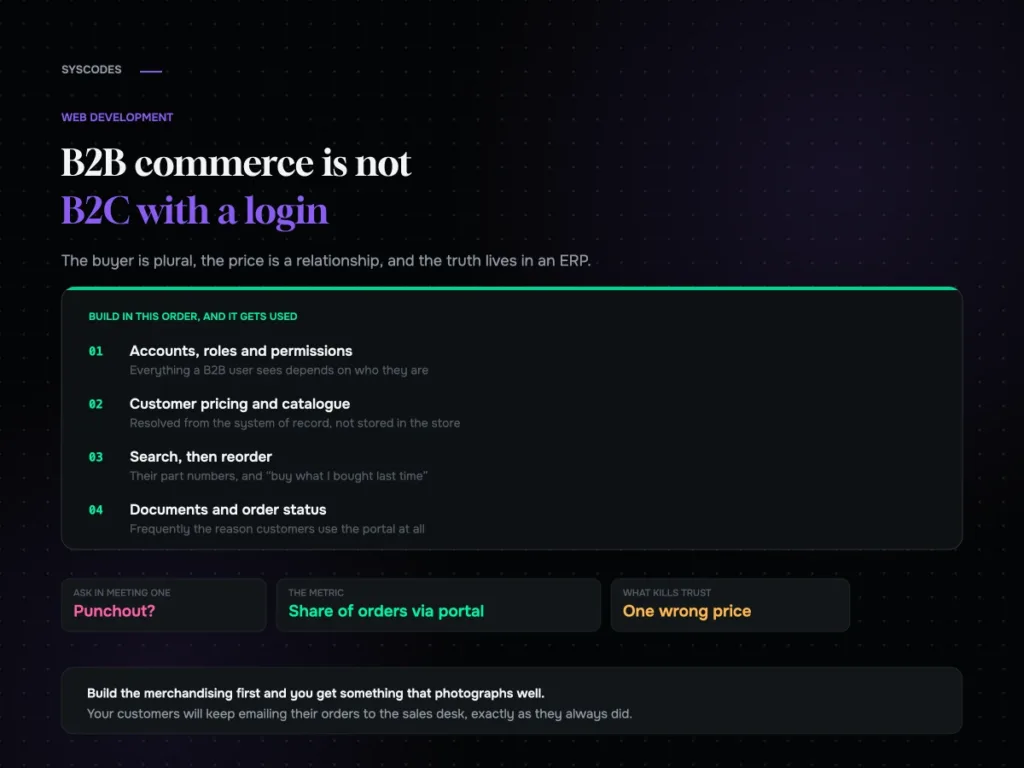
B2B commerce is not B2C with a login: what actually changes
What genuinely changes in a B2B commerce build: account structure, resolved pricing, the order workflow, punchout and ERP integration — and what to build first to…
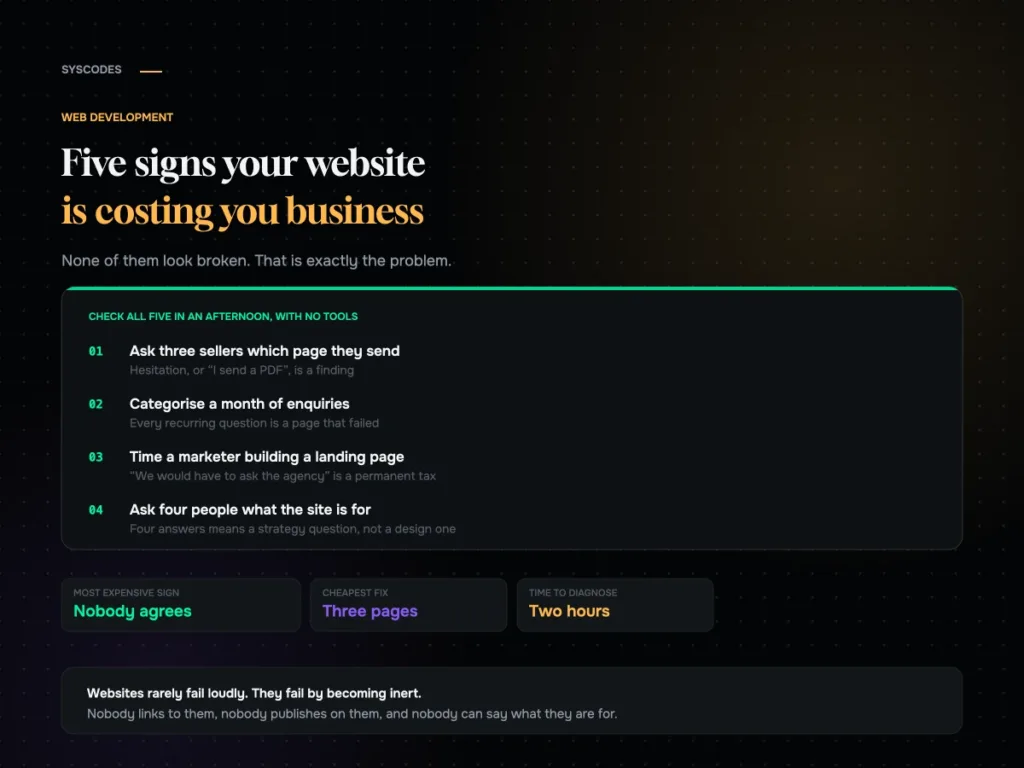
Five signs your website is costing you business
Five quiet signs that a website has stopped earning, how to check every one of them in an afternoon with no tools, what each one costs,…
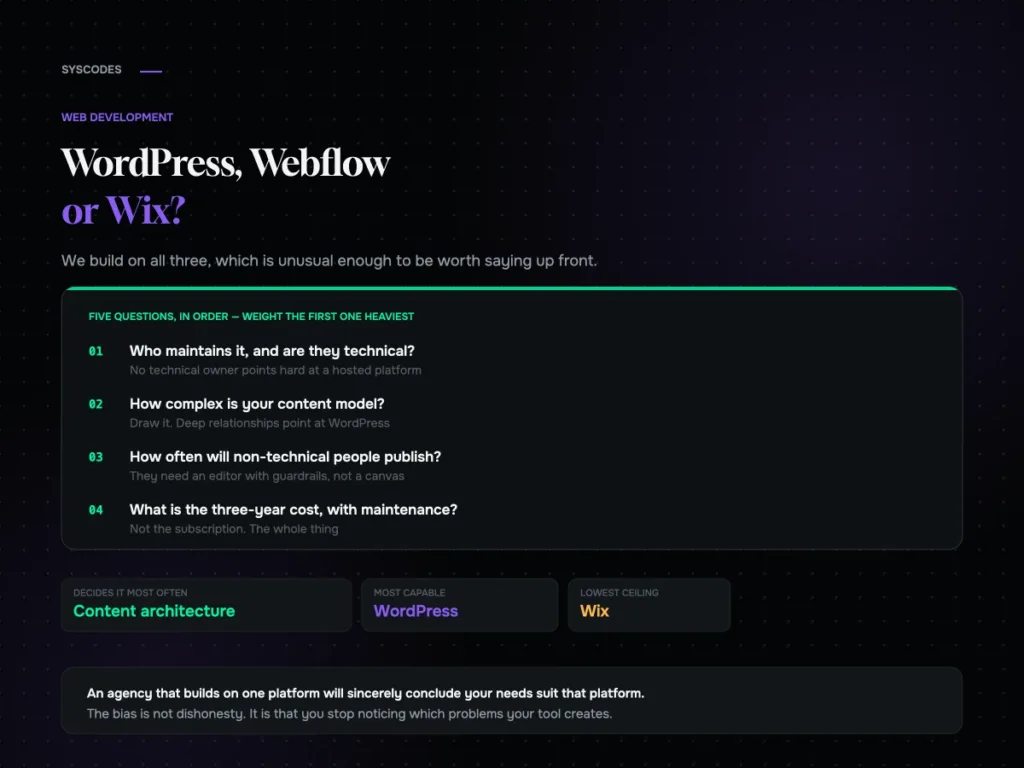
WordPress vs Webflow vs Wix for a growing business
A neutral comparison of WordPress, Webflow and Wix: what each genuinely wins on, where each hurts, the content-model test that settles it, lock-in, and three-year cost.
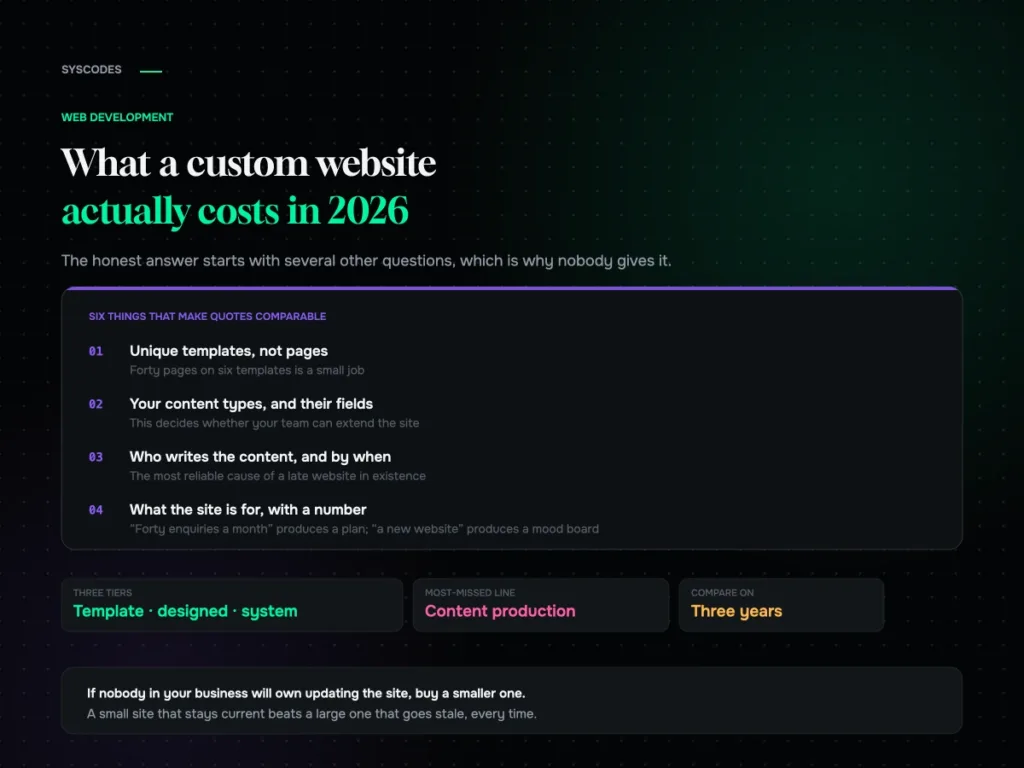
What a custom website actually costs in 2026
The three tiers of website project, the nine lines on every quote, what genuinely moves the number, what a cheap quote quietly removes, and the three-year…