Home/Blog/Web Development
Web Development · 11 min read

What a custom website actually costs in 2026

The honest answer starts with several other questions, which is why nobody gives it. Here it is anyway, with the questions in it.

What a custom website actually costs in 2026
S
Sayan SahaUpdated August 2026 · 11 min read

“How much does a website cost” is a question with a real answer, which nobody gives, because the honest version starts with several other questions and that feels evasive.

So here is the honest version anyway, with the questions in it. What follows is the structure of a website quote, what genuinely moves the number, the lines that get quietly removed to win a deal, and the costs that arrive after launch and never appear on any proposal.

We build these for a living in two markets with very different price levels, so we will also say the thing agencies usually leave out: where the geography changes the number and where it does not.

Three different things called “a website”

Before any number means anything, work out which of these you are buying. Nearly every project is one of the three, and the gap between them is larger than the gap between agencies.
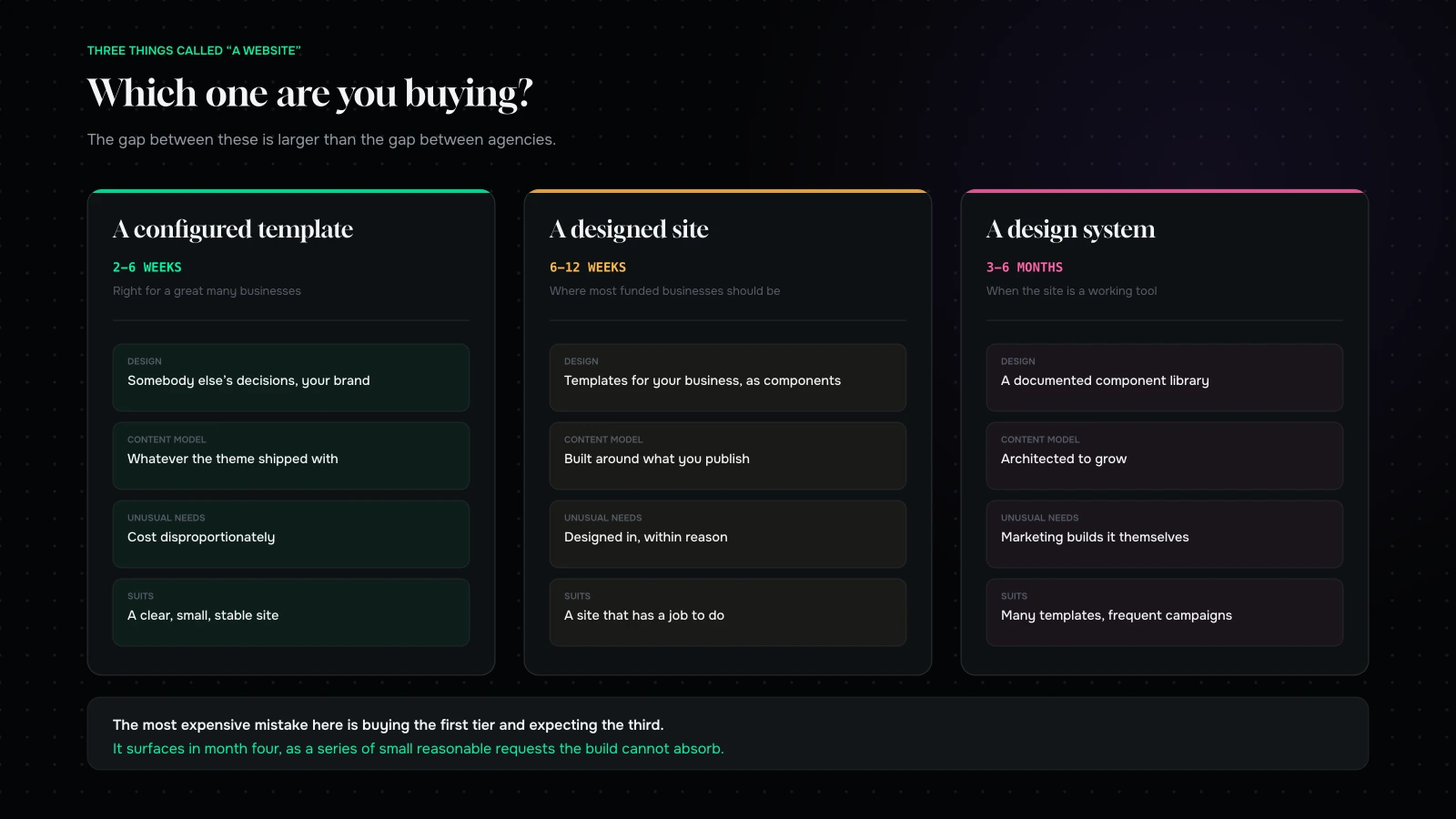
Three tiers of website project — a configured template, a designed site, and a design system — with what each includes and who each suits
Most disagreements about price are really disagreements about which of these three is being bought.

A configured template. A well-chosen theme, your brand applied, your content in it, a handful of layout changes. Fast, cheap, entirely respectable, and the right answer for a large number of businesses. Two to four weeks. The constraint is that you are living inside somebody else’s decisions, and every unusual requirement costs disproportionately.

A designed site. Pages designed for your business rather than adapted from a demo, built as reusable components, with a content model that fits what you actually publish. Six to twelve weeks. This is where most funded businesses should be, and it is the tier where quotes vary the most because “designed” covers everything from a nice homepage to a considered system.

A design system. A component library, documented, with a page-building capability your marketing team can use without a developer, and a content architecture built to grow. Three to six months. Correct when the site is a working tool rather than a brochure — many templates, frequent campaigns, several people publishing.

The most expensive mistake in this whole area is buying tier one and expecting tier three. It shows up in month four as a series of small, reasonable-sounding requests that the build cannot absorb.

What is actually on the invoice

Whatever the presentation, a website quote resolves to these lines. The useful exercise is to find all of them in whatever you have been sent — the missing ones are the ones that come back as change orders.

LineWhat it coversShare of a designed site
Discovery and strategyWhat the site is for, who it is for, what it must do5–10%
Information architectureSitemap, page inventory, navigation, content model5–8%
Content productionWriting, editing, photography, video, illustration10–25%
DesignTemplates, components, states, responsive behaviour20–30%
BuildFront end, CMS integration, page building tools25–35%
IntegrationsCRM, marketing automation, booking, payments, analytics5–15%
SEO and migrationRedirects, metadata, structured data, technical setup3–8%
QA and launchCross-browser, cross-device, accessibility, cutover8–12%
AftercareThe first month, when everything real gets found5%

The line that surprises people is content production, and it is the line most often assumed to be free because “we will write it ourselves”. Which brings us to the most reliable cause of a delayed website in existence.

Content is the schedule, and usually the budget too

Almost every late website is late because of content. Not design, not development — content.

The pattern is identical every time. The client keeps content to save money, which is a legitimate decision. Design proceeds against placeholder text. Build proceeds. Then, in week nine, everything is finished except that seventeen pages of copy need writing by somebody who already has a full-time job, and the project stops for six weeks.

Three honest options. Pay somebody to write it, which costs money and takes a fortnight. Write it yourself before the design starts, which costs nothing and takes longer than you think. Or reduce the site to the number of pages you can actually produce content for, which is usually the best answer and the one nobody suggests.

The related decision is photography. Stock imagery makes a site look like every other site in its category, and good original photography is one of the highest-return line items in a website budget. It is also frequently cut first, because it is visible on the invoice and its absence is not.

What moves the number

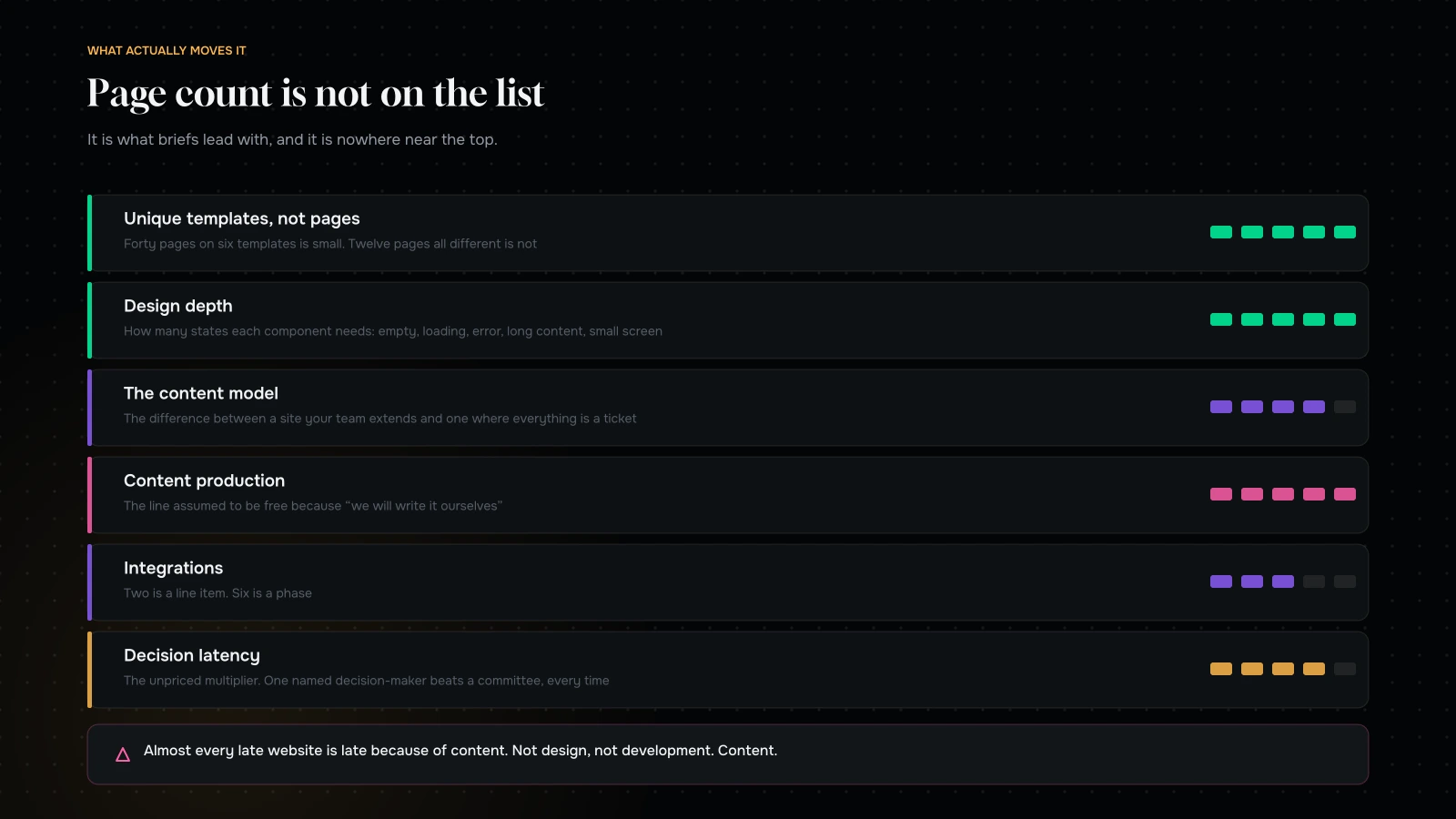
What actually moves a website quote: page count, design depth, content model complexity, integrations, content production and decision latency
Page count is what briefs lead with, and it is nowhere near the top.

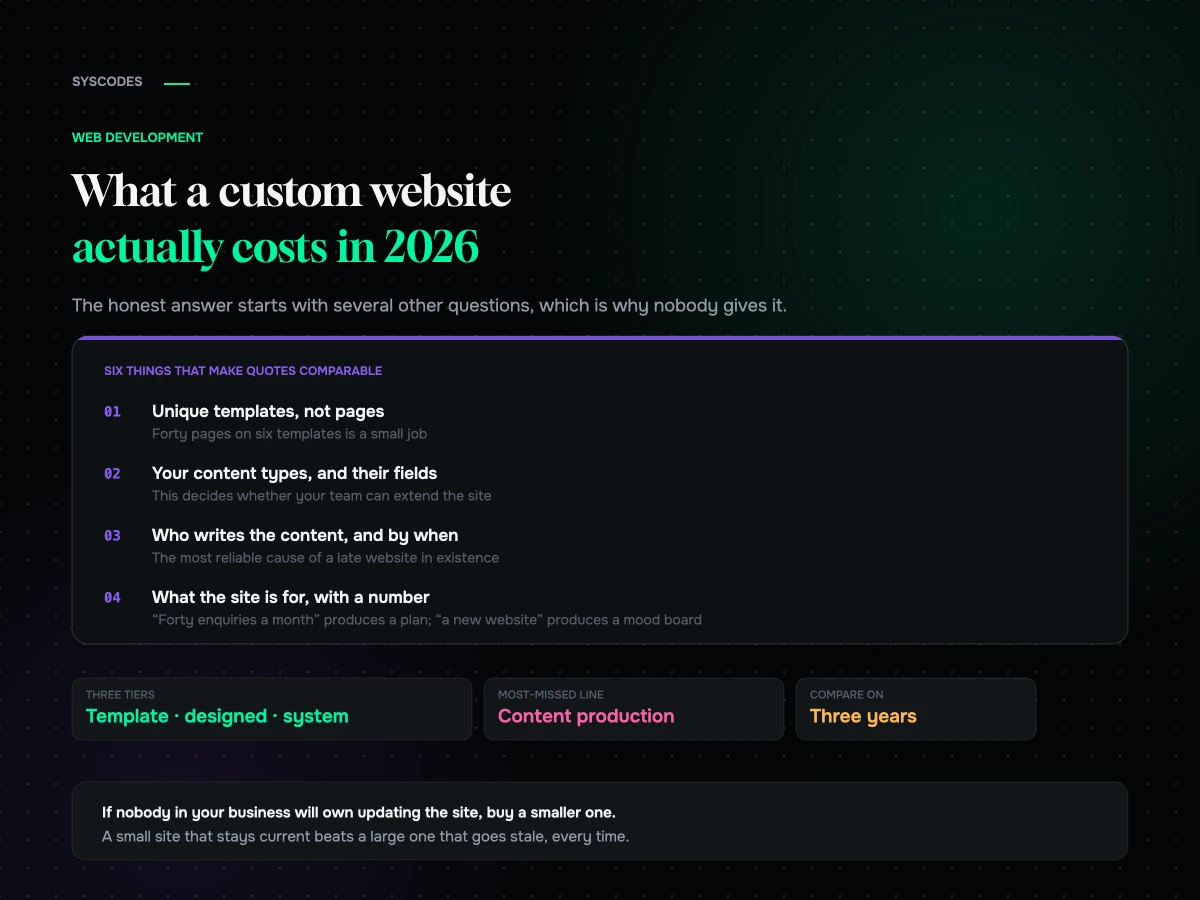
Number of unique templates, not number of pages. Forty pages using six templates is a small job. Twelve pages that are all different is a large one. When you write a brief, count templates.

Design depth. How much of the site is designed rather than assembled, and how many states each component needs — hover, empty, loading, error, long content, short content, small screen. Design depth is invisible in a finished site and it is most of the difference between a build that ages well and one that breaks the first time somebody publishes a long headline.

The content model. How many types of content you have and how they relate. Articles, case studies, people, locations, events, resources, products — each with its own fields and templates. This is the difference between a site your team can extend and one where every new thing is a developer ticket.

Integrations. Each system with its own credentials, field mapping and test cycle. Two is a line item. Six is a phase.

Content production, as above.

Decision latency. The unpriced multiplier. A project with one named decision-maker who replies within a day finishes considerably faster and cheaper than the same project with a committee, and it is the single biggest difference we see between two otherwise identical builds.

What the cheap quote leaves out

There is a reliable pattern to how a low quote becomes an expensive project.

To win on price, something must come out, and what comes out is what a buyer comparing documents cannot see: discovery, the content model, responsive and edge-case design, accessibility, testing, and the first month after launch. The homepage still looks good. The site still launches.

Then the cost arrives in a different currency. A content model that was not designed means every new page type is a quote. Missing edge-case design means the site breaks the first time marketing publishes something slightly unusual. No accessibility work means a remediation project later, and in some markets a legal one. And no aftercare means the fortnight when real users find real problems is billed hourly.

Our rule of thumb, offered without much comfort: the second-cheapest quote is usually the one that read the brief.

The costs that arrive after launch

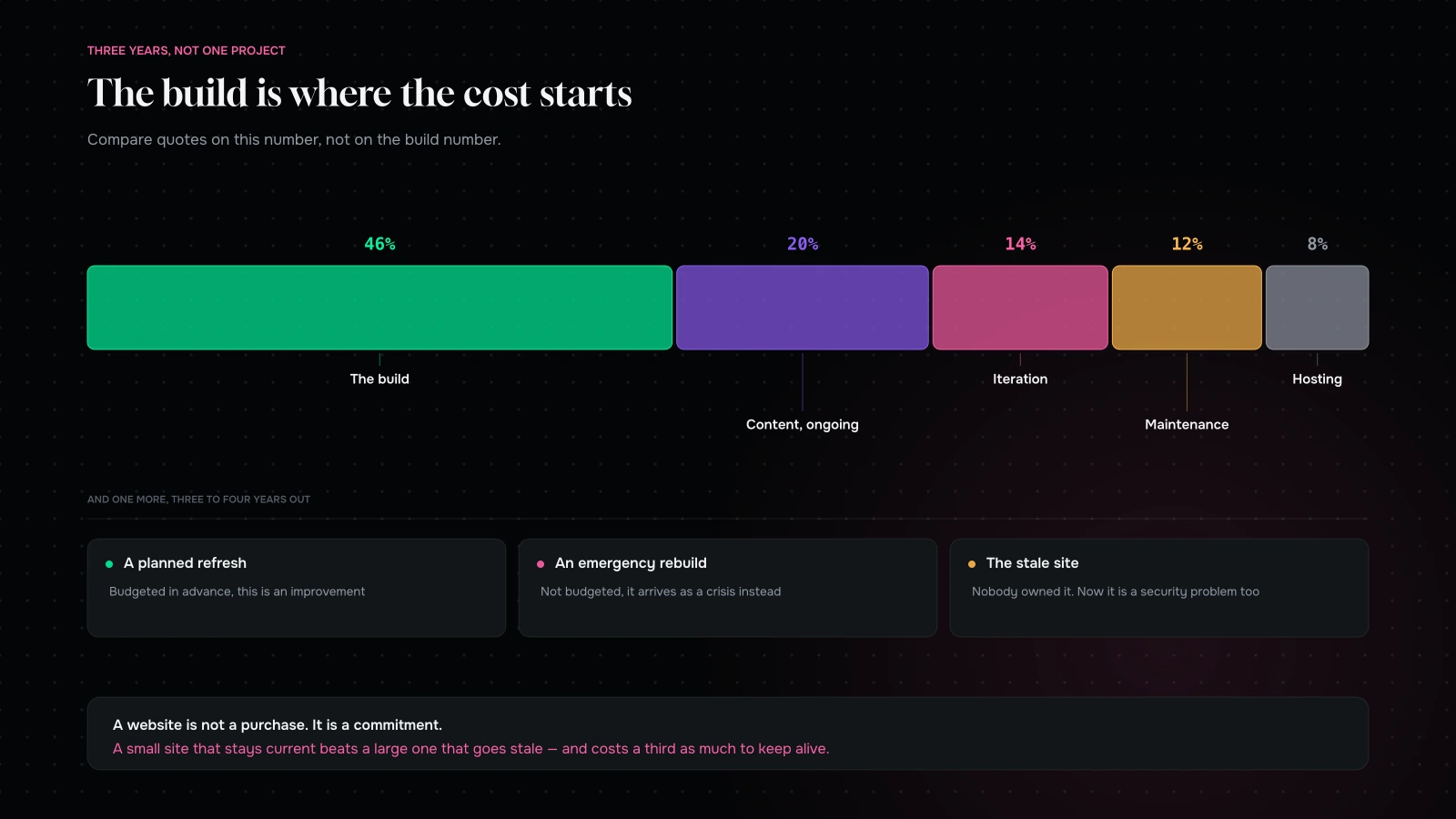
The three-year cost of owning a website: hosting, maintenance, content, iteration and the eventual refresh
The build is a project. The website is a commitment.

A website is not a purchase, it is a commitment, and the ongoing side is routinely left out of the comparison entirely.

Hosting and infrastructure. Modest for most sites, and not zero.

Maintenance. Platform updates, plugin or dependency updates, security patching, backups, uptime monitoring. Someone must own this. The most common failure state we are called into is a site nobody has updated in two years, which is now both a security problem and a functionality problem.

Content. The thing that makes the site work. A site that is not updated stops earning, and every business that treats the launch as the finish line discovers this in about eight months.

Iteration. The site you launch is a hypothesis. Budget something for changing it once real people have used it — this is the highest-return money in the entire lifecycle and it is almost never allocated.

The eventual refresh. Most sites need real work every three to four years. If you budget for that in advance it is a planned improvement; if you do not, it arrives as an emergency rebuild.

Add those up over three years and compare that number, not the build number. It changes which quote is actually cheaper more often than people expect.
Fixed price, day rate, or retainer

Three commercial shapes, and the right one depends less on trust than on how well-defined the work is.

Fixed price suits a project where the scope is genuinely knowable in advance — a defined set of templates, a known content model, named integrations. It transfers risk to the agency, which means the agency prices that risk, which means you pay a premium for certainty. That is a fair trade and usually the right one for a first engagement. The failure mode is that fixed price makes change expensive, so anything you discover mid-project arrives as a negotiation rather than a decision.

Day rate suits work where the shape will emerge — a design system, an ongoing programme, anything exploratory. It is cheaper when things go well and it requires you to actually manage the work. If nobody on your side is watching the burn weekly, do not buy this.

Retainer suits the part everybody underfunds: iteration, content, maintenance and small improvements after launch. A modest monthly commitment that keeps somebody familiar with your site is worth far more than the same money spent in an emergency eighteen months later, when the person who built it has moved on and the first two days go into re-learning the codebase.

The combination we recommend most often is a fixed price for the build and a small retainer afterwards. It gives you budget certainty for the part that is definable and continuity for the part that is not — and it is how most of the sites we are still proud of three years later were bought.

Where geography changes the price, and where it does not

Both of our markets ask this and it deserves a straight answer.

The same designed site costs materially less delivered from India than from a London or New York agency, and the difference is a cost-of-delivery difference rather than a quality one. What it means in practice: an Indian-market budget buys more senior attention than the same number does in the UK, and a Western brand paying Indian rates is usually buying a team rather than a discount.

What does not change with geography: the number of decisions in the project, how long your own team takes to answer questions, and how much content you have to produce. Those are properties of your business and they will dominate your timeline regardless of who builds the site.

Which is why we are sceptical of “we saved sixty percent offshore” stories that describe a nine-month build. That is not a cheaper project. It is a slower one, and slower projects cost more in ways that never appear on an invoice.

How to write a brief that produces comparable quotes

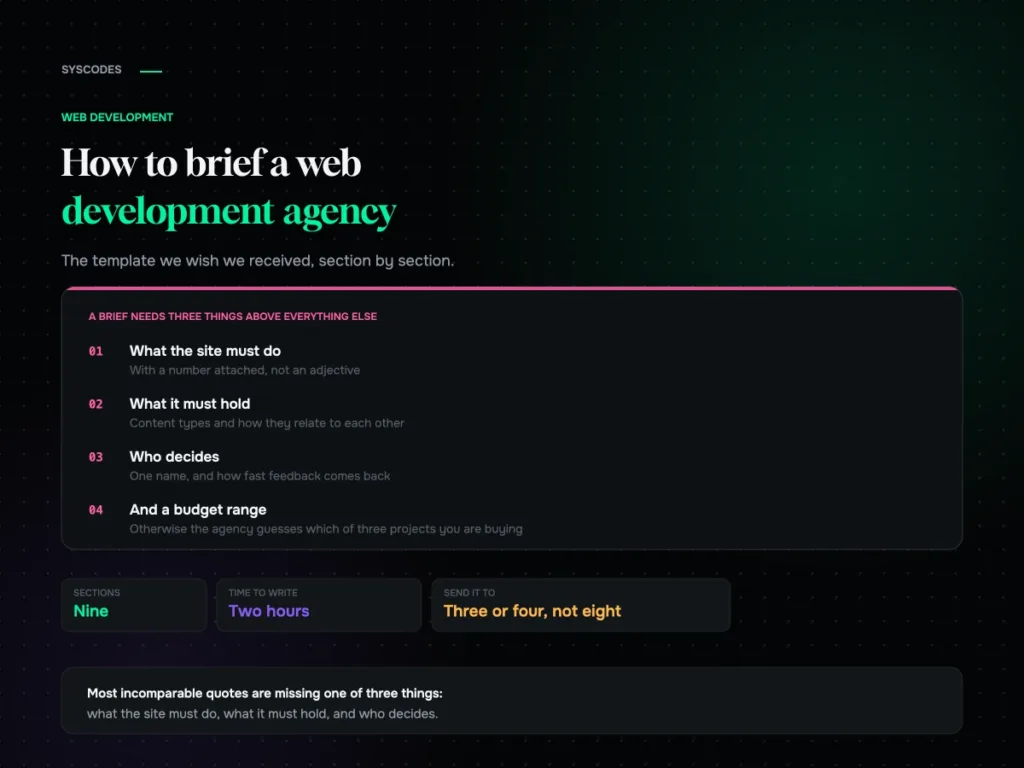
Six things. With these, quotes converge dramatically and you can actually compare them.

  1. The number of unique templates, not the number of pages.
  2. Your content types and roughly what fields each needs.
  3. Every system the site must talk to, named.
  4. Who writes the content and by when.
  5. Who makes decisions, and how quickly.
  6. What the site is for, in one sentence, with a number attached if you have one.

That last one changes proposals more than anything else on the list. “We need a new website” produces a design conversation. “We need to generate forty qualified enquiries a month and the current site produces eleven” produces a plan.

Five questions that separate a good quote from a cheap one

If you have proposals in front of you and they are hard to compare, these four minutes will do it.

“How many unique templates have you priced?” If the answer is a page count, the quote is a guess. If it is a template count with a list, somebody has read the brief.

“What is your content model for our case studies?” Substitute whatever your most structured content type is. A good answer describes fields and relationships. A vague answer means the site will be built as a pile of pages and every future addition is a ticket.

“What happens when marketing needs a new landing page?” The single most predictive question about how the site will feel in year two. If the answer is “they ask us”, price that as a recurring cost, because it is one.

“What is excluded?” Good agencies have a list ready. If nothing is excluded, nothing has been scoped.

“What does the first month after launch look like, and is it in the price?” The line most often deleted to win, and the one you will want most.

Two ways this goes wrong that are nobody’s fault

The site is designed before anyone knows what it says. Design against real content and you get a site that fits your business. Design against placeholder text and you get a beautiful layout that your actual words do not fit into, followed by a month of arguing about whether to cut the words or redo the design. Write the top five pages first, even badly, even in a document. It changes everything downstream.

Nobody decided who the site is for. Every website has at least three audiences pulling at it — customers, recruits, investors, partners, existing clients looking for support. A site trying to serve all of them equally serves none of them well, and the arguments this produces show up as endless rounds of homepage revisions that are really an unresolved strategy question.

Both of these are cheap to solve at the start and extremely expensive to solve in week nine, which is when they usually surface.

What good looks like six months later

A useful test to apply to any proposal: imagine the site half a year after launch and ask four questions.

Has anything been published since launch? If the answer would be no, you have bought a brochure and should have bought a smaller one.

Can somebody non-technical build a new page that looks right? If not, every campaign has a development dependency and the marketing calendar is now a queue.

Does it still work when the content is longer than the design assumed? This is what edge-case design buys you, and it is the first thing cut from a cheap quote.

Does anybody know who is responsible for updating it? If the answer is a shrug, the security patching is not happening either.

A site that passes those four is worth substantially more than a prettier one that does not, and the difference is almost entirely decided in the lines of the quote that buyers skim.

What we would cut, in order

If the budget will not stretch, some things are much safer to remove than others.

Page count. Fewer, better pages beat more, thinner ones, and the saving is in content as well as build.

Design ambition on secondary templates. Your homepage, your primary service pages and your contact flow deserve real attention. Your careers page does not, yet.

Bespoke illustration and motion. Lovely. First to go.

Phase-two integrations. Anything a person can do manually at current volume can wait.

And what we would not cut, in any circumstances: the content model, responsive and edge-case design, accessibility, testing on real devices, and the first month after launch. Those five are the difference between a website and a liability.

What it comes down to

A website does not have a price because “a website” is three different products. Work out which tier you are buying, count templates rather than pages, decide who is writing the content before anything is designed, and compare quotes on the three-year number rather than the build number.

Then be honest about the last one. If nobody in your business will own updating the site, buy a smaller one — a small site that stays current beats a large one that goes stale, every time, and it costs a third as much to keep alive.

Want a real number rather than a range? Send us what the site needs to do, roughly how many unique templates you think you need, and who is writing the content, through the contact form. We will come back with which tier you are actually in, the three lines most likely to move, and what we would cut first if the budget is tighter than the brief.

You can also read how to brief a web development agency, or WordPress vs Webflow vs Wix.

A range is not an answer

Tell us what the site needs to do, and who is writing the content.

We will come back with which of the three tiers you are actually buying, the three lines most likely to move, and what we would cut first if the budget is tighter than the brief.

If the honest answer is that a well-configured template does everything you need, we will say so. It is a smaller invoice and a site you will keep current.

NDA on request · you will hear back from Sayan or a senior lead, never a bot
Question about your project? Tell us in 30 seconds — a senior lead replies.